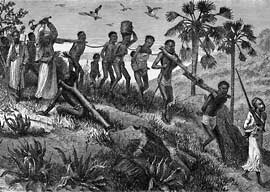
If there is a historical weapon more powerful and decisive than
guns, it is certainly guilt. Those who seek to conquer will wield the
primitive biblical notion of collective guilt as a bludgeon to dampen a
rival group’s spirit and their willingness to resist. Guilt is injected
like a fatal virus into entire populations to demoralize and weaken
them. And at least as far as whites in the West are concerned, it is
working like a charm.
Without so much as asking a single question, many modern whites have
gullibly swallowed a skewed and incomplete historical narrative that
depicts them as history’s sole villains and the nonwhite world as
innocent, suffering lambs.
Alas, despite the cheering warmth such simplicities afford to simple
minds, life is never that simple, and as any honest student of history
knows, there is no such thing as “good guys”—there are only bad guys who
won and bad guys who lost.
Whenever I note that when it comes to the emotionally hypersensitive
topic of slavery, there is more than enough historical guilt to go
around and that slavery’s history cannot neatly be boxed into binary
struggles of good versus evil or black versus white, I am invariably
accused of trying to alleviate or deny the guilt that we are ceaselessly
lectured whites should constantly be torturing ourselves with.
“If there is a historical weapon more powerful and decisive than guns, it is certainly guilt.”
If one dares to point out that Africans were vastly complicit in the
African slave trade, one is accused of trying to “deny” white guilt or
to “absolve” whites of guilt, or of trying to argue that “two wrongs
make a right.”
No, dummies. Two wrongs make two wrongs. But the question is: Why do you focus only on one
wrong? It would seem that in all cases, the ones who are truly trying
to “deny” guilt or “absolve” themselves of it are the ones who insist
everyone focus merely on one wrong rather than all of them. Humanity, regardless of color, will never suffer a shortage of guilt.
Many black apologists and their white enablers will outright deny that Africans sold Africans into slavery. The always interesting Nation of Islam
argues that these treacherous go-betweens weren’t truly “African”
anyway—they were instead Portuguese Jewish half-breeds known as lancados
who’d deliberately interbred with indigenous Africans in order to
swindle and kidnap them before handing them over to Jewish slave traders
who’d shlep them to the Americas.
To many others for whom the overwhelming evidence of African
collaboration in the slave trade becomes impossible to deny, they’ll
leap through flaming poodle hoops trying to make excuses. They’ll allege
that African slavery was more benign than all other forms…or that
Africans who sold other Africans to Islamic and European slavers had no
idea how brutally the victims would be treated…or that they didn’t
consider one another “black” but rather enemies from warring tribes, as
if that makes it any better ethically…or that it was only a handful of
African Judases and Uncle Toms who sold their continental kin into New
World bondage and was not in any way an established, officially
mandated, and integral part of several sub-Saharan economies.
Nearly all modern historians agree that the scenario depicted by Alex Haley in Roots—that
of white raiders penetrating the African interior to rout African
villages for slaves—is fraudulent. Instead, European slave traders
nearly always bought slaves from African vendors at coastal markets. We
hear much about the brutal “Middle Passage” across the Atlantic Ocean,
but almost never about the estimated 10 million or so indigenous
Africans who perished while being marched to the sea in chains and yokes
by their African captors.
We don’t hear that according to Boston University’s Linda Heywood and
John Thornton, about 90% of Africans transported to the New World had
initially been enslaved by other Africans. We don’t hear about Tippu Tip,
who was once a world-famous black slave trader in Zanzibar. And we
certainly don’t hear much about how Barack Obama—who has no ancestral
ties to African slaves in America—is descended from the Luo peoples, who
routinely captured other Africans in war and sold them into slavery.
But when the Transatlantic Slave Trade was still active, what did
African blacks and their American descendants have to say? Glad you
asked:
“…I must own, to the shame of my own countrymen, that I was first
kidnapped and betrayed by some of my own complexion, who were the first
cause of my exile and slavery…If there were no buyers there would be no
sellers.”
—African abolitionist Ottobah Cugoano (1757-1791)
“The savage chiefs of the western coasts of Africa, who for ages have
been accustomed to selling their captives into bondage and pocketing
the ready cash for them, will not more readily accept our moral and
economical ideas than the slave traders of Maryland and Virginia….We
are, therefore, less inclined to go to Africa to work against the slave
trade than to stay here to work against it.”
—Frederick Douglass
And here’s what several prominent modern African leaders have to say about the subject:
“African
chiefs were the ones waging war on each other and capturing their own
people and selling them. If anyone should apologize, it should be the
African chiefs. We still have those traitors here even today.”
—Ugandan President Yoweri Museveni, 1998
“I want to apologize for the role my ancestors played in the slave
trade….I knew one day I wanted to come to this land and ask forgiveness
of my black brothers and sisters. I wanted to cross the ocean to see the
land where my ancestors suffered.”
—King Kpoto-Zounme Hakpon III of Benin to a black audience in Alabama, 2013
“We cannot continue to blame the white men, as Africans, particularly
the traditional rulers, are not blameless….In view of the fact that the
Americans and Europe have accepted the cruelty of their roles and have
forcefully apologised, it would be logical, reasonable and humbling if
African traditional rulers…[can] accept blame and formally apologise to
the descendants of the victims of their collaborative and exploitative
slave trade.”
—Civil Rights Congress of Nigeria, 2009
“I believe there is a great psychic shadow over Africa, and it has
much to do with our guilt and denial of our role in the slave trade. We
too are blameworthy in what was essentially one of the most heinous
crimes in human history.”
—Former Ghanaian diplomat to the UN Kofi Awoonor, 1994
I have endlessly more respect for modern African leaders who are
willing to acknowledge their ancestors’ role in slavery than I do for
modern ethno-masochistic whites that try, against all evidence, to
isolate guilt only on the white side and smear all whites from here to
eternity with the invisible shit stain of guilt. I also have far more
respect for these African leaders than I do any modern American blacks
who blame whites, and only whites, for every last drop of black
suffering.
If I feel a kinship with anyone, it is with those who are intelligent
and noble enough to acknowledge that history is unbearably complex and
is more reasonably viewed as a power struggle between winners and losers
rather than good guys and bad guys. In the end, only morons strain to
justify historical events, while wise men merely try to understand them.
“To live honestly is to hurt no one, and give to every one his due.”-Lysander Spooner
Lysander Spooner was a Boston legal scholar and philosopher during
the nineteenth century. What makes this man of Massachusetts valuable to
the legacy of the Southern tradition is that Spooner was a consistent
proponent of Jeffersonian Classical Liberalism*. There are two
characteristics that are the most prominent to Lysander Spooner and his
works. The first is his strong individualist personality. The second is
his uncompromising dedication to the use of reason and evidence in the
formation of his conclusions. Spooner would never shy from controversy
in the name of defending morals or logic, and this dedication makes his
works stimulating and often enjoyable for anyone of any degree of
interest in studying them. Lysander Spooner was indeed a great
philosopher and scholar both in his and our time.
Spooner published writings on nearly every subject, from economics,
to religion, to copyright law. He even set out on an entrepreneurial
venture of a private mail company to compete with the United States Post
Office. To chronicle Spooner’s career in its entirety is beyond the
scope of this work. This work will focus on two of Spooner’s positions, his position on slavery and his position on the war between the North and South.
Lysander Spooner was an abolitionist, but he was unique amongst other
opponents of slavery in the North. Spooner didn’t believe that
extra-legal or violent measures were necessary to end slavery. Instead
he turned one of slavery’s biggest defenses against itself. Slavery was
often claimed to be protected under the Constitution, leading to fiery
activists like William Lloyd Garrison to claim that the Constitution was
a “covenant with death” and an “agreement with Hell”. Spooner disagreed
with such sentiment and wrote a detailed essay in 1840 titled The Unconstitutionality of Slavery
where he uses his characteristically analytical legal interpretation to
prove by peaceful and lawful means that slavery should be done away
with. It has even been reported that after reading Spooner’s arguments,
Frederick Douglas changed his views on the Constitution from those of
Garrison to be in agreement with Spooner. The arguments Spooner makes
are (in brief summary) that the Constitution must be read literally, and
that arguments based upon hidden intent or implication on the part of
the Founding Fathers’ words were illegitimate; from this principle,
Spooner argued that since slavery wasn’t explicitly protected under the
Constitution it couldn’t be defended as if it were. Spooner also claimed
that because the Constitution was designed for the defense of human
liberty, it could be argued that if it had to be used in a debate
regarding slavery; it could only be used against the institution.
Spooner would perform a similar analysis of the Constitution decades
later (this will be explained later on). It is important to note that
the literal interpretation of the words of the Constitution was
championed by Thomas Jefferson, as opposed to Alexander Hamilton’s
theory that the Constitution had implied powers that could be inferred
almost arbitrarily by any politician who happens to interpret the
document in a specific manner.
Like other abolitionists, Spooner disagreed with the Fugitive Slave
Act, and would attempt to provide lawyers with legal loopholes in the
law to help protect escaped slaves from being returned to their owners.
Spooner did deviate from his desire for peaceful abolition when he
supported John Brown’s raid on Harper’s Ferry. Spooner even went as far
as to propose a plan for abolitionists to kidnap the governor of
Virginia, in order to facilitate a prisoner exchange for Brown. The plan
for an uprising against the slave owners was of course, never
executed, but it is evidence of one of the periods of Spooner’s life
where his intellectual prowess led him to frustration and arguably even
desperation with the people of his time. It is also important to note,
that Spooner consistently emphasized the importance of appealing to the
non-slave owners in the South in order to foster friendship, and to
detach abolitionist ideals from their perception as being geographic
antagonism.
There is no question of Spooner’s dedication to the abolitionist
cause, a moral crusade that he defended with the utmost zeal and
determination. Due to this, it will probably surprise many readers that
on the outset of the War Between the States, Spooner defended the
Confederate States of America. In much contrast to other abolitionists
and war hawks in the North, Spooner despised the Republican Party, and
the Union war effort. He argued that the war wasn’t over slavery, but
for the Northern politicians to maintain an illegitimate dominion over
the South. He openly criticized the members of the Republican party
before and during the war. In a letter to William H. Seward dated in
1860, he recounts that Senator Albert Brown of Mississippi reacted to The Unconstitutionality of Slavery
by saying, “the book is ingeniously written. No mere simpleton could
ever have drawn such an argument. If his premises were admitted, I
should say at once that it would take a Herculean task to overthrow his
argument.” Spooner, attacking the Republican’s desire to protect slavery
while attempting to gain abolitionist social support, gives Seward this
statement; “Thus an open advocate of slavery from Mississippi,
virtually makes more concessions to the antislavery character of the
constitution, than a professed advocate of liberty, from New York…”
Spooner also stated that the Republicans were “doublefaced demagogues”
and that he desired to “embarrass” their plans to “ride into power on
the two horses of Liberty and Slavery”. In 1864 Spooner wrote a letter
to Charles Sumner where he challenges him on the same point. He
criticizes Sumner as being a concessioner for slavery, while boasting of
being in favor of abolition. He even cites a conversation that was
reported to him by an associate of his where Sumner claimed that
Spooner’s arguments put forth in The Unconstitutionality of Slavery
were correct. But since Sumner never attacked slavery on a
constitutional basis, and favored making war with the South, Spooner, in
this letter calls him a “deliberately perjured traitor to the
constitution, to liberty, and to truth.” He also states that the
Republican’s refusal to attack slavery through constitutional arguments
“placed the North wholly in the wrong, and the South wholly in the
right.” Spooner, despite his temporary support for John Brown, had
believed that violence was not necessary to abolish slavery (especially
violence against non-slaveholders which comprised the majority of the
Confederate population!). Spooner thunders upon Sumner and all of
history with this sentence; ”You, and others like you have done more,
according to your abilities, to prevent the peaceful abolition of
slavery, than any other men in the nation…”. Spooner’s letters to Sumner
and Seward offer an important perspective for anyone interested in the
Jeffersonian tradition in American history as well as an abolitionist
perspective on the role of slavery in the War Between the States. The
letters show not just hypocrites in American politics, but a also a man
whose dedication to truth transcended the comfort of social convenience,
and popular politics.
Lysander Spooner’s quest for justice was far from finished. In the
years after the war, Spooner wrote a series of essays that offered a
methodical analysis of the current nature of the United States
Constitution, and of the Union that had supposedly been preserved. There
were six essays, but essays three through five are now lost to history,
the titles that we have now are; No Treason (1), No Treason: The Constitution (2), and No Treason: The Constitution of No Authority (6). These
essays are perhaps the finest examples of Jeffersonianism in Spooner’s
work. A few summaries are necessary to emphasize this point.
The first essay offers a critique of the Northern point of view for
the war. The essay is as scathing as his words to the previously
mentioned Republican senators. For example, he contested the
proclamation that the Union saved the idea of voluntary government and
self-determination, a claim that was championed by Abraham Lincoln
himself in his Gettysburg Address. Spooner wrote in No Treason,
“the late war has practically demonstrated that our government rests
upon force – as much so as any government that ever existed.” and “In
proportion to her wealth and population, the North has probably expended
more money and blood to maintain her power over an unwilling people,
than any other government ever did.” The general theme of Spooner’s
argument in this essay is, that a government of consent necessarily
means the consent of every individual human being that is to live under
that government is required for that government to be called voluntary
and free and that it is the right of every individual to terminate any
voluntary association with each other if they have the desire to do so.
This principle could extend to individuals acting in concert i.e.,
States seceding from the Union. He concludes this essay with, “…the
principle of individual consent, the little government that mankind
need, is not only practicable, but natural and easy; and that the
Constitution of the United States authorizes no government, except one
depending wholly on voluntary support.”
This conclusion to the first essay is expanded upon in the second
essay. In this piece, Spooner provides arguments that conclude that the
Constitution and the government it prescribes are only valid and just if
it depends exclusively upon voluntary support. He prefaces his argument
by describing the preamble to the Constitution in this way, “The
meaning of this is simply We, the people of the United States, acting
freely and voluntarily as individuals, consent and agree that we will
cooperate with each other in sustaining such a government as is provided
for in this Constitution.” He chooses to emphasize the idea that
individuals, not the States, ratified the Constitution, with the purpose
of saying that even if this were the case, the Lincolnian argument
still is invalid and unjust even if it is conceded that the Constitution
wasn’t ratified by the States. He argues that, “Any one man, or any
number of men, have had a perfect right, at any time, to refuse his or
their further support; and nobody could rightfully object to his or
their withdrawal.” Thus, he argues that secession or dissolution is an
intrinsic human right. Spooner, also validates the Southern argument
though, he follows up the previous quote with this statement, “On the
other hand, if we say that the adoption was the act of the States, as
States, it necessarily follows that they had the right to secede at
pleasure….” Furthermore, Spooner argued in this essay that Southerners
were innocent of treason against the United States, and he compared them
with the American revolutionaries of 1776.
The sixth essay entitled, No Treason: The Constitution of No Authority
is the longest and hardest hitting essay. He spends nearly the first
half of the essay making arguments as to how the Union had become
illegitimate. He even includes a legal argument for those who served as
Confederate soldiers designed to help them exempt themselves from oaths
pledging loyalty to the federal government. This is in striking
similarity to his work in finding legal loopholes in the Fugitive Slave
Act decades earlier. This and other arguments that he wrote in this
series of essays were published in Southern magazines, like De Bow’s Review.
Spooner’s arguments regarding the Union, and government itself, are
intricate and complex in scale and substance, and will not be discussed
further here. What will be emphasized is the second half of the essay,
which elaborates upon what Spooner argued, was the true nature of the
War Between the States. Spooner explicitly states that, “The pretense
that the “abolition of slavery” was either a motive or justification for
the war, is a fraud…” He declares that the Union was motivated solely
to exploit the Southern economy for the benefit of the corrupt Northern
businesses that were the real power behind the Republican Party. Spooner
argues that slavery could have been abolished peacefully, the war could
have been prevented and, “a thousand times nobler union than we have
ever had would have been the result.” If the abolitionist, Lysander
Spooner’s support for Southerners was ever in doubt before, one could be
satisfied with his final barrage against the Northern view of the war,
“All these cries of having “abolished slavery,” of having “saved the
country,” of having “preserved the union,” of establishing “a government
of consent,” and of “maintaining the national honor,” are all gross,
shameless, transparent cheats – so transparent that they ought to
deceive no one – when uttered as justifications for the war, or for the
government that has succeeded the war, or for now compelling the people
to pay the cost of the war, or for compelling anybody to support a
government that he does not want.”
Lysander Spooner was a forcible personality in his own time. But his
influence is still felt today, most prominently amongst modern
Libertarians like Tom Woods (author of The Politically Incorrect Guide to American History). His essay, The Unconstitutionality of Slavery was cited in the, District of Columbia v. Heller Supreme
Court case as evidence in favor of preventing the ban of handguns.
Spooner offers an important perspective for those who want to understand
Southern history and the history of the War Between the States. The
nature of the philosophy he advocated also serves to prove the
universality of many of the principle that are held by the Southern
Tradition. Considering just these examples from a lifelong career of
Spooner’s battles for advancing freedom, it is no mystery as to why his
gravestone in Massachusetts bears the title, “Champion of Liberty”. *Lysander Spooner never explicitly gave a name to any ideology
that he purported, only citing Natural Law and universal principles in
his works, but these universal principles and axioms, namely those of
individual rights, property rights, and self-determination are all
integral to Jeffersonian thought. In addition to this, a man named
Benjamin Tucker, a close associate of Spooner, identified the principles
that he and Spooner advocated for as “unterrified Jeffersonianism.” Sources:
No Treason: The Constitution of No Authority http://static1.squarespace.com/static/55a3c833e4b07c31913e6eae/t/55a90c38e4b0865180f14a45/1437142072769/NO+TREASON.n6.pdf
No Treason: The Constitution http://static1.squarespace.com/static/55a3c833e4b07c31913e6eae/t/55a90c2de4b0865180f14a12/1437142061276/NO+TREASON.n2.pdf
No Treason http://static1.squarespace.com/static/55a3c833e4b07c31913e6eae/t/55a90c20e4b0865180f149d5/1437142048361/NO+TREASON.n1.pdf
Spooner’s Letter to Sumner http://static1.squarespace.com/static/55a3c833e4b07c31913e6eae/t/55a5263fe4b0c83122fb55c4/1436886591736/Letter+to+Charles+Sumner.pdf
Spooner’s Letter to Seward http://static1.squarespace.com/static/55a3c833e4b07c31913e6eae/t/55a51643e4b0ada672912c84/1436882499285/SESP012260.pdf
Wikipedia entry for Lysander Spooner https://en.wikipedia.org/wiki/Lysander_Spooner#cite_note-25
Lysander Spooner Biography http://www.lysanderspooner.org/biopgraphy/
About Matt De Santi
Matt De Santi is a high school senior in California interested in the Southern tradition. More from Matt De Santi
Conventional wisdom of the moment tells us that the great war of
1861—1865 was “about” slavery or was “caused by” slavery. I submit that
this is not a historical judgment but a political slogan. What a war is
about has many answers according to the varied perspectives of different
participants and of those who come after. To limit so vast an event as
that war to one cause is to show contempt for the complexities of
history as a quest for the understanding of human action.
Two generations ago, the most perceptive historians, much more
learned than the current crop, said that the war was “about” economics
and was “caused by” economic rivalry. The war has not changed one bit
since then. The perspective has changed. It can change again as long as
people have the freedom to think about the past. History is not a
mathematical calculation or scientific experiment but a vast drama of
which there is always more to be learned.
I was much struck by Barbara Marthal’s insistence in her Stone Mountain
talk on the importance of stories in understanding history. I entirely
concur. History is the experience of human beings. History is a story
and a story is somebody’s story. It tells us about who people are.
History is not a political ideological slogan like “about slavery.”
Ideological slogans are accusations and instruments of conflict and
domination. Stories are instruments of understanding and peace.
Let’s consider the war and slavery. Again and again I encounter
people who say that the South Carolina secession ordinance mentions the
defense of slavery and that one fact proves beyond argument that the war
was caused by slavery. The first States to secede did mention a threat
to slavery as a motive for secession. They also mentioned decades of
economic exploitation and the seizure of the common government for the
first time ever by a sectional party declaredly hostile to the Southern
States. Were they to be a permanently exploited minority, they asked?
This was significant to people who knew that their fathers and
grandfathers had founded the Union for the protection and benefit of ALL
the States.
It is no surprise that they mentioned potential interference with
slavery as a threat to their everyday life and their social structure.
Only a few months before, John Brown and his followers had attempted
just that. They murdered a number of people including a free black man
who was a respected member of the Harpers Ferry community and a
grand-nephew of George Washington because Brown wanted Washington’s
sword as a talisman. In Brown’s baggage was a constitution making him
dictator of a new black nation and a supply of pikes to be used to stab
to death the slave-owner and his wife and children.
It is significant that not one single slave joined Brown’s attempted
blow against slavery. It was entirely an affair of outsiders.
Significant also is that six Northern rich men financed Brown and that
some elements of the North celebrated him as a saint, an agent of God,
ringing the church bells at his execution. Even more significantly,
Brown was merely acting out the venomous hatred of Southerners that had
characterized some parts of Northern society for many years previously.
Could this relentless barrage of hatred directed by Northerners
against their Southern fellow citizens have perhaps had something to do
with the secession impulse? That was the opinion of Horatio Seymour,
Democratic governor of New York. In a public address he pointed to the
enormity of making war on Southern fellow citizens who had always been
exceptionally loyal Americans, but who had been driven to secession by
New England fanaticism.
Secessionists were well aware that slavery was under no immediate
threat within the Union. Indeed, some anti-secessionists, especially
those with the largest investment in slave property, argued that slavery
was safer under the Union than in a new experiment in government.
Advocates of the “slavery and nothing but slavery” interpretation
also like to mention a speech in which Confederate Vice-President
Alexander Stephens is supposed to have said that white supremacy was the
“cornerstone” of the Confederacy. The speech was ad hoc and
badly reported, but so what? White supremacy was also the cornerstone of
the United States. A law of the first Congress established that only
white people could be naturalized as citizens. Abraham Lincoln’s
Illinois forbade black people to enter the State and deprived those who
were there of citizenship rights.
Instead of quoting two cherry-picked quotations, serious historians
will look into more of the vast documentation of the time. For instance,
in determining what the war was “about,” why not consider Jefferson
Davis’s inaugural address, the resolutions of the Confederate Congress,
numerous speeches by Southern spokesmen of the time as they explained
their departure from the U.S. Congress and spoke to their constituents
about the necessity of secession. Or for that matter look at the entire
texts of the secession documents.
Our advocates of slavery causation practice the same superficial and
deceitful tactics in viewing their side of the fight. They rely mostly
on a few pretty phrases from a few of Lincoln’s prettier speeches to
account for the winning side in the Great Civil War. But what were
Northerners really saying?
I am going to do something radical. I am going to review what
Northerners had to say about the war. Not a single Southern source,
Southern opinion, or Southern accusation will I present. Just the words
of Northerners (and a few foreign observers) on what the war was
“about.”
Abraham Lincoln was at pains to assure the South that he intended no
threat to slavery. He said he understood Southerners and that
Northerners would be exactly like them living in the same circumstances.
He said that while slavery was not a good thing (which most Southerners
agreed with) he had no power to interfere with slavery and would not
know what to do if he had the power. He acquiesced in a proposed 13th
Amendment that would have guaranteed slavery into the 20th century.
Later, he famously told Horace Greeley that his purpose was to save the
Union, for which he would free all the slaves, some of the slaves, or
none of the slaves. The Emancipation Proclamation itself promised a
continuance of slavery to States that would lay down their arms.
All Lincoln wanted was to prevent slavery in any territories, future
States, which then might become Southern and vote against Northern
control of the Treasury and federal legislation. From the anti-slavery
perspective this is a highly immoral position. At the time of the
Missouri Compromise, Thomas Jefferson and James Madison said that
restricting the spread of slavery was a false, politically motivated
position. The best thing for the welfare of African Americans and their
eventual emancipation was to allow them to spread as thinly as possible.
Delegation after delegation came to Lincoln in early days to beg him
to do something to avoid war. Remember that 61% of the American people
had voted against this great hero of democracy, which ought to have led
him to a conciliatory frame of mind. He invariably replied that he could
not do without “his revenue.” He said nary a word about slavery. Most
of “his revenue” was collected at the Southern ports because of the
tariff to protect Northern industry and most of it was spent in the
North. Lincoln could not do without that revenue and vowed his
determination to collect it without interruption by secession. He knew
that his political backing rested largely on New England/New York money
men and the rising power of the new industrialists of Cleveland,
Detroit, and Chicago who were aggressively demanding that the federal
government sponsor and support them. The revenue also provided the
patronage of offices and contracts for his hungry supporters, without
which his party would dwindle away.
Discussing the reaction to secession, the New York Times
editorialized: “The commercial bearing of the question has acted upon
the North. We were divided and confused until our pockets were touched.”
A Manchester, N.H., paper was one of hundreds of others that agreed,
saying: “It is very clear that the South gains by this process and we
lose. No, we must not let the South go.”
Meanwhile, the U.S. Congress officially declared that the war WAS NOT
AGAINST SLAVERY but to preserve the Union. (By preserving the Union, of
course, they actually meant not preserving the real Union but ensuring
their control of the federal machinery.)
At the Hampton Roads peace conference a few months before Appomattox,
Lincoln suggested to the Confederate representatives that if they
ceased fighting then the Emancipation Proclamation could be left to the
courts to survive or fall. Alexander Stephens, unlike Lincoln, really
cared about the fate of the black people and asked Lincoln what was to
become of them if freed in their present unlettered and propertyless
condition. Lincoln’s reply: “Root, hog, or die.” A line from a minstrel
song suggesting that they should survive as best they could. Lincoln
routinely used the N-word all his life, as did most Northerners.
A statement in which Lincoln is said to favour voting rights for
black men who were educated or had been soldiers has been shown to be
fraudulent. Within a few days of his death he was still speaking of
colonization outside the U.S.
The South, supposedly fighting for slavery, did not respond to any of
these offers for the continuance of slavery. In fact, wise Southerners
like Jefferson Davis realized that if war came it would likely disrupt
slavery as it had during the first war of independence. That did not in
the least alter his desire for the independence and self-government that
was the birthright of Americans. Late in the war he sent a special
emissary to offer emancipation if European powers would break the
illegal blockade.
Saying that the South was fighting only to defend the evils of
slavery is a deceitful back-handed way to suggest that, therefore the
North was fighting to rid America of the evils of slavery. Nothing could
be further from the truth. First of all, secession did not necessarily
require war against the South. That was a choice. Slavery had existed
for over two hundred years and there was no Northern majority in favour
of emancipation. Emancipation was not the result of a moral crusade
against evil but a byproduct of a ruthless war of invasion and conquest.
Not one single act of Lincoln and the North in the war was motivated by
moral considerations in regard to slavery.
Even if slavery was a reason for secession, it does not explain why
the North made a war of invasion and conquest on a people who only
wanted to be let alone to live as they had always lived. The question of
why the North made war is not even asked by our current historians.
They assume without examination that the North is always right and the
South is always evil. They do not look at the abundant Northern evidence
that might shed light on the matter.
When we speak about the causes of war should we not pay some
attention to the motives of the attacker and not blame everything on the
people who were attacked and conquered? To say that the war was
“caused” by the South’s defense of slavery is logically comparable to
the assertion that World War II was caused by Poland resisting attack by
Germany. People who think this way harbor an unacknowledged assumption:
Southerners are not fellow citizens deserving of tolerance but bad
people and deserve to be conquered. The South and its people are the
property of the North to do with as they wish. Therefore no other
justification is needed. That Leninist attitude is very much still alive
judging by the abuse I receive in print and by e-mail. The abuse never
discusses evidence, only denounces what is called “Neo-Confederate” and
“Lost Cause” mythology. These are both political terms of abuse that
have no real meaning and are designed to silence your enemy unheard.
Let us look at the U.S. Senate in February 1863. Senator John Sherman
of Ohio, one of the most prominent of the Republican supporters of war
against the South, has the floor. He is arguing in favour of a bill to
establish a system of national banks and national bank currency. He
declared that this bill was the most important business pending before
the country. It was so important, he said, that he would see all the
slaves remain slaves if it could be passed. Let me repeat this. He would
rather leave all the slaves in bondage rather than lose the national
bank bill. This was a few weeks after the issuing of the Emancipation
Proclamation.
What about this bill? Don’t be deceived by the terminology. So-called
National Banks were to be the property of favoured groups of private
capitalists. They were to have as capital interest-bearing government
bonds at a 50% discount. The bank notes that they were to issue were to
be the national currency. The banks, not the government, had control of
this currency. That is, these favoured capitalists had the immense power
and profit of controlling the money and credit of the country. Crony
capitalism that has been the main feature of the American regime up to
this very moment.
Senator Sherman’s brother, General Sherman, had recently been working
his way across Mississippi, not fighting armed enemies but destroying
the infrastructure and the food and housing of white women and children
and black people. When the houses are burned, the livestock taken away
or killed, the barns with tools and seed crops destroyed, fences torn
down, stored food and standing crops destroyed, the black people will
starve as well as the whites. General Sherman was heard to say: “Damn
the niggers! I wish they were anywhere but here and could be kept at
work.”
General Sherman was not fighting for the emancipation of black
people. He was a proto-fascist who wanted to crush citizens who had the
gall to disobey the government.
The gracious Mrs. General Sherman agreed. She wrote her husband thus:
“I hope this may not be a war of emancipation but of
extermination, & that all under the influence of the foul fiend may
be driven like swine into the sea. May we carry fire and sword into
their states till not one habitation is left standing.”
Not a word about the slaves.
As the war began, the famous abolitionist Theodore Weld declared that
the South had to be wiped out because it is “the foe to Northern
industry—to our mines, our manufactures, our commerce.” Nothing said
about benefit to the slaves. The famous abolitionist Henry Ward Beecher
enjoyed a European tour while the rivers of blood were flowing in
America. Asked by a British audience why the North did not simply let
the South go, Beecher replied, “Why not let the South go? O that the
South would go! But then they must leave us their lands.”
Then there is the Massachusetts Colonel who wrote his governor from the South in January 1862:
“The thing we seek is permanent dominion. . . . They
think we mean to take their slaves? Bah! We must take their ports, their
mines, their water power, the very soil they plow . . . .”
Seizing Southern resources was a common theme among advocates of the
Union. Southerners were not fellow citizens of a nation. They were
obstacles to be disposed of so Yankees could use their resources to suit
themselves. The imperialist impulse was nakedly and unashamedly
expressed before, during, and after the war.
Charles Dickens, who had spent much time in the U.S. a few years
before the war, told readers of his monthly magazine in 1862: “The
Northern onslaught upon slavery was no more than a piece of specious
humbug designed to conceal its desire for economic control of the
Southern states.”
Another British observer, John Stuart Mill, hoped the war would be
against slavery and was disappointed. “The North, it seems,” Mill wrote,
“have no more objections to slavery than the South have.”
Another European thinker to comment was Karl Marx. Like many later
Lincoln worshippers, Marx believed that the French Revolution was a
continuation of the American Revolution and Lincoln’s revolution in
America a continuation of the French. He thought, wrongly, that Lincoln
was defending the “labour of the emigrant against the aggressions of the
slave driver.” The war, then, is in behalf of the German immigrants who
had flooded the Midwest after the 1848 revolutions. Not a word about
the slaves themselves. Indeed, it was the numbers and ardent support of
these German immigrants that turned the Midwest from Democrat to
Republican and elected Lincoln. It would seem that Marx, like Lincoln,
wanted the land for WHITE workers.
Governor Joel Parker of New Jersey, a reluctant Democratic supporter
of the war, knew what it was all about: “Slavery is no more the cause of
this war than gold is the cause of robbery,” he said. Like all Northern
opponents and reluctant supporters of Lincoln, he knew the war was
about economic domination. As one “Copperhead” editor put it: the war
was simply “a murderous crusade for plunder and party power.” “Dealing
in confiscated cotton seems to be the prime activity of the army,” he
added.
Wall Street agreed and approved. Here is a private circular passed among bankers and brokers in late 1861:
“Slavery is likely to be abolished by the war power and
this I and my friends are all in favor of, for slavery is but the owning
of labor and carries with it the care of the laborers, while the
European plan, led on by England, is that capital shall control labor by
controlling wages. The great debt that capitalists will see to it is
made out of the war must be used as a means to control the volume of
money.”
It is not clear whether this is authentic or a satire, but it tells the truth whichever.
The libertarian Lysander Spooner, an abolitionist, called the Lincoln
rule “usurpation and tyranny” that had nothing to do with a moral
opposition to slavery. “It has cost this country a million of lives, and
the loss of everything that resembles political liberty.”
Here is Frederick Douglass, the most prominent African American of the 19th century:
“It must be admitted, truth compels me to admit . . .
Abraham Lincoln was not, in the fullest sense of the word, either our
man or our model. In his interests, in his associations, in his habits
of thought, and in his prejudices, he was a white man. He was
preeminently the white man’s president, entirely devoted to the welfare
of white men. He was ready and willing at any time . . . to deny,
postpone, and sacrifice the rights of humanity in the colored people to
promote the welfare of the white people of his country.”
What better testimony is needed that emancipation was a by-product,
not a goal, of a war of conquest. Let me repeat: emancipation was a
by-product of the war, never a goal.
How about these curiosities from the greatest of Northern
intellectuals, Emerson. He records in his journals: “But the secret, the
esoteric of abolition—a secret, too, from the abolitionist—is, that the
negro and the negro-holder are really of one party.” And again, “The
abolitionist wishes to abolish slavery, but because he wishes to abolish
the black man.” Emerson had previously predicted that African Americans
were like the Dodo, incapable of surviving without care and doomed to
disappear. Another abolitionist, James G. Birney, says: “The negroes are
part of the enemy.”
Indeed a staple of Northern discourse was that black people would and
should disappear, leaving the field to righteous New England
Anglo-Saxons. My friend Howard White remarks: “Whatever his faults
regarding slavery, the Southerner never found the existence of Africans
in his world per se a scandal. That particular foolishness had its roots in the regions further North.”
In 1866, Boston had a meeting of abolitionists and strong Unionists.
The speaker, a clergymen, compared the South to a sewer. It was to be
drained of its present inhabitants and “to be filled up with Yankee
immigration . . . and upon that foundation would be constructed a new
order of things. To be reconstructed, the South must be Northernized,
and until that was done, the work of reconstruction could not be
accomplished.” Not a word about a role for African Americans in this
program.
One of the most important aspects of the elimination of slavery is
seldom mentioned. The absence of any care or planning for the future of
black Americans. The Russian Czar pointed this out to an American
visitor as a flaw that invalidated the fruits of emancipation. We could
fill ten books with evidence of Northern mistreatment of black people
during and after the war. Emancipation as it occurred was not a happy
experience. To borrow Kirkpatrick Sale’s term, it was a Hell. I
recommend Kirk’s book Emancipation Hell and Paul Graham’s work When the Yankees Come, which are available here.
I suspect many Americans imagine emancipation as soldiers in blue and
freed people rushing into one another’s arms to celebrate the day of
Jubilee. As may be proved from thousands of Northern sources, the Union
solders’ encounter with the black people of the South was overwhelmingly
hate-filled, abusive, and exploitive. This subject is just beginning to
be explored seriously. Wrote one Northerner of Sherman’s men, they “are
impatient of darkies, and annoyed to see them pampered, petted and
spoiled.” Ambrose Bierce, a hard-fighting Union soldier for the entire
war, said that the black people he saw were virtual slaves as the
concubines and servants of Union officers.
Many black people took to the roads not because of an intangible
emancipation but because their homes and living had been destroyed. They
collected in camps which had catastrophic rates or mortality. The army
asked some Northern governors to take some of these people, at least
temporarily. The governors of Massachusetts and Illinois, Lincoln’s most
fervid supporters, went ballistic. This was unacceptable. The black
people would be uncomfortable in the North and much happier in the
South, said the longtime abolitionist Governor Andrew of Massachusetts.
Happier in the South than in Massachusetts?
What about those black soldiers in the Northern army, used mainly for
labour and forlorn hopes like the Crater? A historian quotes a Northern
observer of U.S. Army activities in occupied coastal Carolina in 1864.
Generals declared their intention to recruit “every able-bodied male in
the department.” Writes the Northern observer: “The atrocious
impressments of boys of fourteen and responsible men with large
dependent families, and the shooting down of negroes who resisted, were
common occurrences.”
The greater number of Southern black people remained at home. They
received official notice of freedom not from the U.S. Army but from the
master who, when he got home from the Confederate army, gathered the
people, told them they were free, and that they must work out a new way
of surviving together.
Advocates of the war was “caused by slavery” say that the question has
been settled and that any disagreement is from evil and misguided
Neo-Confederates deceived by a “Lost Cause” myth.
In fact, no great historical question can ever be closed off by a
slogan as long as we are free to think. Howard White and I recently put
out a book about the war. Careful, well-supported essays, by 16 serious
people. Immediately it appeared on amazon, someone wrote in: “I’m so
tired of the Lost Cause writing. Don’t believe the bullshit in this
useless pamphlet.” He could not have had time to actually read the book.
It can be dismissed unread because he has the righteous cause and we do
not. This is not historical debate. It is the propaganda trick of
labeling something you do not like in order to control and suppress it.
Such are those who want the war to be all about slavery—hateful,
disdainful, ignorant, and unwilling to engage in honest discussion.
But if you insist on a short answer solution as to what caused the
war I will venture one. The cause of the greatest bloodletting in
American history was Yankee greed and hatred. This is infinitely
documented before, during, and after the war.
Glory, Glory, Halleluhah
Clyde Wilson is a distinguished Professor Emeritus of History at the
University of South Carolina where he was the editor of the multivolume
The Papers of John C. Calhoun. He is the M.E. Bradford Distinguished
Chair at the Abbeville Institute. He is the author or editor of over
thirty books and published over 600 articles, essays and reviews. More from Clyde Wilson
The State Bank of the Russian Empire in Moscow. This building now houses the Central Bank of the Russian Federation.
THE RUSSIAN REVOLUTION took place at a time of
remarkable financial stability and progress in the Russian Empire.
Russia was the only major power in the world not indebted to central
bankers concentrated around the famous Rothschild banks. The Russian
government printed the nation’s money, regulated the money supply
(unlike the monetary system in America today) and issued low interest
loans through commercial banks.
Festival in a Siberian village, c. 1900
In his book, “A History of Central Banking and the Enslavement of
Mankind,” (Black House Publishing, 2014) Stephen Mitford Goodson
describes the state of Russia before the Bolshevik uprising:
On June 12, 1860 The State Bank of the
Russian Empire was founded with the aim of boosting trade turnovers and
the strengthening of the monetary system. Up to 1894 it was an auxiliary
institution under the direct control of the Ministry of Finance. In
that year it was transformed into being the banker of the bankers and
operated as an instrument of government’s policy. It minted and printed
the nation’s coins and notes, regulated the money supply and through
commercial banks provided industry and commerce with low interest rate
loans. Its vast gold reserves, the largest in the world, exceeded the
bank note issue by more than 100%, except for the year 1906. By 1914 it
had become one of the most influential lending institutions in Europe.
Not unexpectedly Russia had the smallest
national debt in the world. The following table reflects the number of
rubles of debt per inhabitant.
By 1914 83% of the interest and
amortization of the national debt, of which less than 2% was held
abroad, was funded by the profits of the Russian State Railways. In 1916
the total length of the main lines was 100,817 verst or kilometers.
Russian commercial and canal tonnage of 11,130,000 in 1910 exceeded
British merchant tonnage of 10,750,000.
In 1861 Tsar Alexander II (1855-81)
abolished serfdom, which at that time affected 30% of the population. By
1914 very little land remained in the possession of the Russian estate
owners, who were mainly the nobility. 80% of the arable land was in the
hands of the peasants, which had been ceded to them for a very small
sum. This land was held in trust by the village commune or mir. However,
after the passing of the Stolypin Act in 1906, peasants could obtain
individual title with hereditary rights. By 1913, two million families
had availed themselves of this opportunity to ac1uire what became known
as “Stolypin farms.” Nearly 19,000,000 acres (7,689,027 hectares) were
alloted to these individual peasant proprietors by the land committees.
The Peasants’ State Bank, which was described at that time as the
“greatest and most socially beneficent institution of land credit in the
world” granted loans at a low rate of interest, which was in effect a
handling charge. Between 1901 and 1912 these loans increased from 222
million rubles to 1,168 billion rubles.
Agricultural production soared so that by
1913, Russia had become the world’s bread basket as the following table
reveals. [Not included. The table shows that Russia produced 42 percent
of the world’s barley, 67 percent of its rye, 31 percent of its wheat
and 30 percent of its oats].
Russian agricultural production of
cereals exceeded the combined production of Argentina, Canada and the
United States by 25%. In 1913 Russia had 37.5 million horses – more than
half of all those in the world. She also produced 80% of the world’s
flax and provided more than 50% of the world’s egg imports. Mining and
industrial output also expanded by huge margins. Between 1885 and 1913
coal production increased from 259.6 million poods (16.38 kg) to 2,159.8
million poods, cast iron production rose from 25 million poods in 1890
to 1,378 million poods in 1913 and petroleum production rose from 491.2
million poods in 1906 to 602.1 million poods in 1916. From 1870 to 1914
industrial output grew by 1% per annum in Great Britain, 2.75% per annum
in the United States and 3.5% per annum in Russia. During the period
from 1890 to 1913 industrial production quadrupled and Russian
industries were able to satisfy 80% of internal demand for manufactured
goods – a perfect example of autarky. Throughout the last 20 years of
peacetime imperial rule (1895-1914) the increase in Gross Domestic
Product averaged 10% per annum.
With the Russian State bank creating the
people’s money out of nothing at almost zero interest; as opposed to the
rest of the world where central banks allowed parasitic private banks
to create their nation’s money supply at usurious rates of interest, it
comes as no surprise to find that in 1912 Russia had the lowest levels
of taxation in the world. These very low rates of taxation also attest
to the efficiency of the Russian government. Furthermore throughout this
period of state banking there was no inflation and no unemployment.
[Table not include. Total tax rate in
Great Britain was 26.75 percent per inhabitant, compared to 2.66 percent
per inhabitant Russia.]
An independent study by British lawyers
concluded that the Russian Code of Laws and judiciary were “the most
advanced and impartial in the world.”
Elementary education was obligatory and
free right up to university level, where only nominal fees were charged.
Between 1906 and 1914 10,000 schools were opened annually. Russian
universities were renowned for their high academic standards.
In labor relations the Russians were
pioneers. Child labor was abolished over 100 years before it was
abolished in Great Britain in 1867. Russia was the first industrialized
country to pass laws limiting the hours of work in factories and mines.
Strikes, which were forbidden in the Soviet Union, were permitted and
minimal in Tsarist times. Trade union rights were recognized in 1906,
while an Inspectorate of Labor strictly controlled working conditions in
factories. In 1912 social insurance was introduced. Labor laws were so
advanced and humane that President William Taft of the United States was
moved to say that “the Emperor of Russia has passed workers’
legislation which was nearer to perfection than that of any democratic
country.”
The people of all races in the Russian
empire had an equality of status and opportunity, which was unparalleled
in the modern world. His Imperial majesty Tsar Nicholas II (1894-1917)
and his state bank had created a workers’ paradise that was unrivaled in
the history of mankind.
On November 7, 1917, the Rothschilds,
fearful that replication of this extraordinary example of freedom and
prosperity would destroy their malevolent banking empire, instigated and
financed a Judeo-Bolshevik revolution in Russia (50), which wrecked and
ruined a wonderful country and resulted in the deaths by murder and
starvation, according to Alexander Solzhenitsyn, of 66 million innocent
people. (51)
[A History of Central Banking and the Enslavement of Mankind, Stephen Mitford Goodson, Black House Publishing, London, 2014; pp. 77-83]
My favorite
Southron Paleface called me a pineapple a couple of posts ago that elicited a hearty Laugh Out Loud In teh Real Life from me.
He followed up the with this: "...see, racists can make racist nicknames
against each other. in the good ol' days that meant camaraderie!"
Commenter Victor Michaelson weighed in as well: "It reminded me of the
America I grew up in, where guys could razz their buddies and it wasn't a
Federal offense."
Damn straight you raciss crackers!
We got a special word for you melanin-deficient and solar-sensitive folks here in Hawaii: Haole (pronounced "How-Lee").
From the greatest movie ever filmed in Hawaii
Most folks that have never been to Hawaii, or who have only visited
briefly on vacation, have usually only heard of the word haole
associated with only negative, racist connotations...the equivalent of
the "N-word" for white folks.
That's simply not true. It's a very versatile word and can be used as a
simple adjective, a term of endearment or employed as a provocative
epithet. As a fair-complexioned (but not totally pale) hapa-haole mutt,
I've had the term used on myself in all of these contexts at one time or
another. Yet, whenever haole folks come to Hawaii and find themselves
being referred by that term, they almost always take immediate offense.
Take this guy for instance:
More haole den haole...
Shua ting, brah, you one human...but you still one haole.
But seriously, let's take a closer look at where this term came from.
It's a common myth that the term comes from the Hawaiians who first
encountered Captain Cook and his crew's pale faces, they called them
Ha'ole, a compound word made from combining Ha- meaning breath, with 'ole meaning without.
This legend is up for debate, as the linguists who study Hawaiian
language and the Pidgin English have belabored to dispel the commonly
accepted origin. To the credentialed classes, haole is it's own Hawaiian word, and it simply means foreigner:
So if we are to literally go by the textbook, haole really
doesn't have anything to do with white skin. In theory, yes, but in
practice, no. Thanks to the deluge of immigration from all corners of
the globe mixing and miscegenating for a couple of centuries, Hawaii is
the so-called ideal "melting pot" our modern day SJW's and progressives
say they are supposedly working towards with the rest of the world. In
such a chaotic environment of so many different skin tones, hair and eye
colors, race is the first way we immediately identify each other, and
in that context, haole means white.
I do believe Hawaii is the ideal "melting pot" society....but there are
two distinct features about what we have here that makes it much
different from the progressive/SJW ideal.
First thing that makes it "work" is we are all race realists, race
conscious and racist to the core. It's the only way we can all get
along. We don't try to uphold some unrealistic, mystical feeling of
holiness attributed to the supposedly ideal paradigm of "color
blindness." In fact, we have the exact opposite. We're more color aware,
we're all equal opportunity racists. We LOVE our stereotypes and our
racist jokes. At least that was the Hawaii I grew up in. Because of
this, we all have similar words like haole that are used to designate
all the various races that call our islands home. We got similar words
for the Japanese, Chinese, Koreans, Samoans, Micronesians, Filipinos,
Puerto Ricans, Vietnamese, and Hispanics. Most of these terms are just
like haole - they can serve as simple adjectives or spitefully intended
perjoratives. In most cases, you just add the word fuckin' in front, and
the harmless adjective turns into hateful, bigoted and racist
invective.
Here's a song from the 70's from Hawaiian music's most popular act of
that era, the Beamer Brothers. with one of their most popular songs that
is still sung and played by musicians at parties and backyard jams
everywhere in the islands to this day. In this song, all of the major
ethnic groups and their sterotypes regarding their cultural practices
and socio-economic status are fair game for good natured-ribbing:
The ending of the song really highlights the main point of this post here:
One thing I when notice 'bout this place
All us guys we tease the other race
It's amazing that we can all live in the same place
I sadly see more and more of the next generation of local folks
accepting the progressive SJW mind rot programming of "equality" and
"anti-racism," and our common culture is suffering for it. For decades,
local stand up comedians made entire careers out of night club routines
and television specials making fun of all the races that made up the
multi-ethnic society of 20th century Hawaii. There were no sacred cows.
We were all fair game...and it had us all laughing our asses off. Yeah,
we may have been laughing at you...but then one minute later, it was my
turn and you were now laughing at me too. And thus, we were all both
laughing at and with each other.
This locally produced tell-a-vision show from 1984 could be considered a
good representation of the high point of Hawaii's functionally racist
society. It was a childhood favorite of mine, and I was pleasantly
surprised to find a clip of it posted on youtube.
In case you didn't figure it out yet, while black folks are "foreigners" they are not haole. We call them Popolos.
Hawaiian island/urban legend goes that the first African descendants
who came to our shores where of the particular hue that was so dark, the
Hawaiians thought they looked purple. The Hawaiian word for purple is popolu...hence
popolo. I don't know if it's true or not, but I do know this: just like
the word haole, popolo can be used interchangably as mere adjective, a
term of endearment, or a race-based slur.
Speaking of stereotypes, we local folk also understand that most popolos
that recently arrive from the mainland for are far more sensitive about
race than any other race. We have met more than a few black folks that
quickly figured outpopolo was the Hawaiian word for those of
African ancestry, and many immediately equate it with the N-word in
significance. Not true though. If we are trying to be deliberately
offensive, we'll use the N-word like any other garden variety racist in
the world today.
Nevertheless, if we local folks are trying to talk about black people
and there may be some within hearing distance when we are conversing who
may possibly get offended, we may sometimes say Olopop instead of
Popolo (popolo said backwards).
As I mentioned earlier, I was pleasantly surprised to find the preceding
clip on youtube, because it is not commercially available anywhere here
in 2015. This clip was undoubtedly someone using their smartphone to
video clip their VHS or betamax copy of the program. You see, in the
last decade or so, our formerly somewhat cooperative society of equal
opportunity racism has been infected with the PC mind virus, and the
SJW's holy church of blessed colorblindness has caused many folks to
scream victimhood at racial humor that was one of our mainstays of local
Hawaiian culture of the 20th century. So many of these race-based shows
and stand up comedy routines are no longer available or reproduced or
re-released anymore, out of fear someone or another will get offended
and file a lawsuit to recover damages for their soiled panties or sand
filled ass cracks.
That being said, one of the original local comedians from that earlier
era of racist harmony still seems to be going at it on youtube, and this
clip will give you a pretty good rundown on our history of ethnic
diversity and multi-cultural adaptation with regards to linguistics and
cultural attitudes of our multi-cult society:
This comedian, Andy Bumatai, was one of the most popular stand up
comedians and local tell-a-vision personalities of the 80's. In 2015,
this kind of comedy is increasingly coming under fire. Note his
disclaimer at the beginning of the clip. Even 5-10 years ago, such a
disclaimer would not have been necessary. Times they are a changin'.
More and more of the younger generations of Hawaii's locals have been
assimilated into the PC-SJW Borg by globalized mass media programming
and public education brainwashing.
No siree, it's the 21st century, and we can no longer hurt anyone's FEEEEEEEELLLLLIIINNGS.
Everybody is so fuckin' sensitive. It sucks. I want my openly racist
society back. More and more we see letters to the editors and magazine
articles and tell-a-vision programs pushing the "colorblind" paradigm
and that all of the racist stereotypes that bonded us all together in
common racism in 20th century Hawaii, are now being considered more and
more to be thoughtcrime and badthink that must be expunged from our
consciousness. It makes me sick to see Hawaii's uniquely harmonious and
cooperative society founded on a solid sense of racial differences,
slowly and inexorably being subsumed by the homogenized and globalized
Brave New World Order mass media culture programming of hypersensitivity
and ludicrous "equality."
Up until recently, we didn't have a pretend, fake ideal that everyone
supposedly openly touts while harboring secret racism in their carefully
guarded hearts and circumspect tongues. No siree, here in our island
paradise, we embraced bigotry and race-based differences whole-heartedly
and without reservation.
Our code word for it nowadays is "local humor" I've been to parties
where people asked if it were okay to tell "local jokes," basically
asking permission from all present if it's okay to tell race-based
stereotypical jokes. Most are still down with the program...but more and
more people are starting to reject what was once a proudly and openly
racist society...and from where I sit, we 'aint better off for it.
See...one of the reasons our society of mixed races "works" is because
no matter what race you are or what culture you come from, we have this
overriding culture of "ALOHA SPIRIT" that most people quickly
assimilate to. In many ways, it's similar to how all the different pale
face crackers assimilated into the AMERICAN DREAM in the 19th century.
Anglo-Germanic-Iberian-Mediterranean-Slavic-Aryan-Nordic migrations all
arrived with different cultures and languages, with the only thing in
common being melanin-deficient and solar-sensitive skin. But buying into
the American dream eventually gave us what many now consider simply as
white Americans (or Canadians).
Just as the miscegenation of all those Euro-strains of paleface resulted
in a generic, homogenized race called "white" we have the same thing
here in Hawaii....but it 'aint called Hawaiian. Only those of us with
actual Half-Savage Aboriginal blood in our veins can be called Hawaiian.
Those who are born and raised here, but have no Hawaiian blood, and are
for the most part the Oriental descendents of the plantation workers
imported by the haole sugar barons as third world serfs, they are
something else - "local."
Here are some examples of this common culture of "Aloha spirit" that define "local" off the top of my head:
* We get rush hour traffic as bad as anywhere else in our modern world.
But nobody honks their horns here...ever. Unless it's due to an extreme
situation like an imminent accident or trying to catch someones
attention in a dire situation, we just don't use our car horns like
that. If you find yourself in Hawaiian rush hour traffic and you hear
someone honking their horn in frustration... well there's the fuckin'
haole (regardless of the race of the actual driver.)
* When you try to merge into traffic, put on your traffic signal and in a
manner of moments, someone will let you in, guaranteed. A couple of
fuckin' haole's may blast past you and not let you in, but eventually a
local is going to slow down and hand wave you in. We even let haole's
merge, but then curse them when they don't show appreciation for the
courtesy.
* Speaking of traffic in Hawaii, here's one of our more popular bumper stickers:
* Other than traffic customs, we have a generalized culture of common courtesy like holding the doors open
for complete strangers, and before the ubiquity of cell phones, we
always stopped to help fellow motorists with broke down cars and flat
tires.
* When we eat in self service restaurants, fast food joints and plate
lunch places, we clean up our tables and throw away all of our rubbish.
The first time I went to the US Mainland at age 18, one of the first big
culture shocks I experienced was seeing fast food patrons leave their
trays and rubbish at their tables when they were done eating for the
workers to clean up.
These are just a few examples of what I'm trying to get at. The "melting
pot" ideal can only work when their is a common ideal that various
racial stocks strive to assimilate to.
As the comedian stated in the preceding clip, there are two kinds of
haole, local haole and haole. I believe it actually goes further than
that. In terms of use as a harmless adjective, haole just means white
skin. No more, no less.
As a perjorative, however, it really means a white skinned person who
doesn't conform to local norms aka "No more aloha." Most of us mixed
race mutts and half savage racists of Hawaii got no problem with local
haoles...or even haoles who are not born and raised, but demonstrate an
affinity for the Aloha spirit ethos. Many a local who 'hates' haoles in
general, end up marrying one and making hapa-haole babies. Despite
having a paleface spouse and paleface children, will still "hate" haoles
(the NO ALOHA kine.)
For real kine...some of my best friends are Japs, Pakes, Soles, Kanaks,
Pordagees, Buk Buks, Yobos, Haoles and Popolos. I also know folks of all
said races who I wouldn't piss on if they were on fire.
I once got
into a scrap with a filipino kid in middle school, because he called me a
fuckin' haole. I told him to fuck off, I'm Hawaiian, and that he was a dumb flip
buk buk whose parents came here to pick pineapple for $.05 a day and
that he should take his ass back to the Philipines. We
punched each other in the face a few times, the teachers broke us up,
and we later became friends when we had to serve detention together. He
would often greet me as "haole boy" and
I'd call him buk buk, and we'd laugh as we shook hands.
It's pretty much how we roll here in Hawaii.
In summation, racial awareness plays an important role in Hawaiian
society, but it's not the be all end all. If you "get" what Aloha means,
you can fit and find a comfortable space amongst others, regardless of
your race.
To wrap things up, I offer you this quick guide for HBD-Hawaiian Style.
Since most of the previous section of this post discussed the term
Haole, Whites are omitted here to avoid excessive redundancy. We talked
enough about da haoles.
Blacks: Popolo, Olopops. Most popolos come to
Hawaii as stationed military personnel. Most usually don't get it any
better or worse than any other minority in Hawaii. If they get involved
in an aggressive or violent conflict, the N-word may get used on them,
but popolo is usually preferred. There are no real popolo jokes unique
to Hawaii, as most are just popular black jokes that just substitute the
word popolo for the N-word.
What do you call 1000 popolo skydivers jumping out of da airplanes all at da same time? Nightfall.
Chinese: Pake ('Pah-kay'), Chink, slant-eye, slope, Cha Wan
(chinese name for the rice bowl haircut), Chang. Terms When used
perjoratively, Pake and Chang denote stinginess, miserliness, an
unhealthy love of money and unscrupulous in acquiring it. Most Jewish
jokes will work in Hawaii by substituting Pake. Wot da difference between one Pake and one canoe? Canoes sometimes tip.
How do da Pakes name their children? They copy da sounds of da cash register! Ching! Chang! Chong! Whats da odda way dey name da kids? Dey throw silvah weah down da stairs!
Filipinos: Flip, Buk Buk ('Book-Book'), Manong (Mah-nong).
Notorious for eating goat and dog meat (particularly black dog), avid
gamblers and chicken fighters. Also notorious for living with 30
extended family members in a 3 bedroom townhome...or buying a 3 bedroom
house and building large extensions that resemble Spanish villas, so
they can house 30 more family members.
You heard of da new Filipino cookbook? 101 ways for wok your dog. What do da Buk Buk's call da dog catcha truck? Meals on Wheels
What do Buk Buk's call da Humane Society? (local animal shelter) Foodland! (local grocery store chain)
Japanese: Japanee, Jap, Buddha-head, rice-eye, bolo head, nip.
Haole-fied Japanese are called katonk or banana (yellow on the
outside, white on the inside). The largest homogeneous ethnicity block
in Hawaii. Least likely race to date, marry or even socialize
significantly with all the other races. Back in da school days, if you
wanted to start a scrap with a jap, you said this:
What you said, Buddha-head? Eh, no lie, rice eye! Jews:Haole. Since most Jews are fair skinned,
we don't give them their own racial category. They're just haole. And
we don't really tell Jewish jokes here either. That's what Pake jokes
are for. But that does remind me of the one Jewish joke I once heard at a
party...told by a hapa-haole Jew (he was half Jewish, half Popolo, born
and raised here):
Know how copper wire got invented? A Jew and a Pake were fighting over a penny.
Koreans: Yobo, Kim Chee, Kink (Korean chink), Seoul
Brother (A Korean that acts black). Because Koreans were relatively
late comers in terms of immigration compared to the other Oriental
ethnicities, Korean jokes are not that popular, but there are a few.
Yobo is the Korean word for sweetheart, but in Hawaii, it's used as a
derogatory reference. Most korean jokes are puns off of the word.
Heard of da Korean police man? Yobocop!
Samoans: Sole (So-lay). Due to their reputations as very large,
strong and fierce fighters who are ready to scrap at the drop of a hat,
there are no real derogatory terms for Samoans. Sole is what Samoans
call themselves, and locals usually can use the term casually....but
even using that word wrong with an easy to anger Samoan could prove
volatile. Most Sole fall into two categories: 1) super nice, easy going,
humorous, fun loving and gregarious. 2) Ultra violent, looking for
trouble, very easy to anger and always ready to give Palagi and others a
sase (strike)! Nevertheless, there are a large number of Samoan jokes
that mostly focus on making fun of their speech. These jokes are usually
only told in hushed whispers after checking around to make sure none
are around to hear....
Heard of da Samoan Accoutant? Tua Tua Isa Foa!
Heard of da Samoan who fell off da couch? Sole Fe Lafa Sofa!
Portuguese: Portagee, Pordagee, Pocho, Porcho. Haoles often think
they get the worst of the prejudice jokes in Hawaii. They're wrong.
That would be the Pordagees. Infamous for being obnoxious by talking way
too much, talking without thinking first, and considered the dimmest,
least intelligent race. Take any Polak joke and substitute Pordagee and
you have typical Hawaii pordagee jokes. Despite the joking reputation,
Pordagees are usually quite sharp and witty, and many of the most
popular comedians are proud Pordagees who tell the best-loved Pordagee
jokes.
You heard why get no more ice in Portugal? Da old Pordagee lady with da recipe when die. Know why da Pordagee farmer was feeding his sheep scrap metal? He was trying for raise steel wool.
As I said, their reputation is one of dim wits....but here's a Pordagee joke that belies the stereotype:
Know why Pordagee Jokes are so short? So Hawaiians can understand them.
A Pordagee guy told that one to me after I told him a Pordagee joke. Touche!
Hawaiians: Kanaka, Kanaks, Kanaka Maoli. Oft stereotype is
lazy, indolent; don't like to work. When the haole sugar plantation
owners needed a workforce to farm their sugar, there were not enough
Hawaiians to work because so many had died from introduced diseases like
small pox, measles and STDs. And those that did survive, would still
only work 'Hawaiian style." We can broke ass, but we goin' take one mid
day break when da sun is hottest in da sky. The haole plantation owners
didn't like that one bit, so they brought in all the other immigrants
who would work from sun up to sun down with barely a break for minimal
wages.
Take any lazy jokes about blacks and substitute Hawaiian.
How come da Pakes no like marry Hawaiians? Dey no like kids too lazy for pick sugar cane. How come da Buk Buks no like marry Hawaiians? Dey no like kids too lazy for pick pineapple. How come da Popolos no like marry Hawaiians? Dey no like kids too lazy for steal.
'Aint diversity grand?
Update:
Remember: "Nobody Listens to Turtle".
And Conan's view of the races/race relations:
"There is no racial bigotry here. I do not look down on niggers, kikes, wops or greasers. Here you are all equally worthless."
Dr. Alfred Kinsey was an American zoologist and later
sexologist who founded The Kinsey Institute for Research in Sex, Gender,
and Reproduction. His research on human sexuality sparked controversy
in the ’40s and ’50s…
As the debate over sex education was heating up in Croatia, a country
where 86% of the population identifies as Catholic, Mrs. Kristo found
herself watching The Kinsey Syndrome and Kinsey’s Pedophiles,
documentaries exposing the horrors of Kinsey’s research. These horrors
include Kinsey paying pedophiles to rape children and time it with a
stopwatch. “As I watched the production, I felt sick and disgusted. I
felt awful. I thought: people don’t know what has happened. They need to
know!…”
According to Kinsey’s books, his published research, and the
statements of his assistants in various interviews, not only was
Kinsey’s research flawed, but it was also criminal. Child sexuality
research data was collected from the personal logs of several pedophiles
– one in particular kept detailed diaries of over 800 sexual encounters
with children, and even with babies as young as two months old. Kinsey
also collected data and financially compensated fathers who were
sexually abusing their own children. He even collaborated with infamous
Nazi pedophile Dr. Fritz von Balluseck, who diarized his sexual abuse of
hundreds of pre-adolescent girls and boys. At the trial of von
Balluseck, the judge criticized Kinsey for not having reported these
crimes to police…
As a result of his questionable “research,” Kinsey made unbelievable
statistical claims, including the following: 10-36% of men are
homosexual; homosexuality, incest, rape, pedophilia, and even bestiality
are normal, and 95% of men engage in these behaviors; 40% of married
women are having affairs; 25% of married women are having abortions.
This abortion statistic is said to have been the catalyst in convincing
lawmakers to legalize abortion.
In the film Kinsey’s Pedophiles, Dr. Paul Gebhard, Kinsey co-author,
states on camera that the Kinsey team solicited child abusers and
obtained child “sexuality” data from pedophiles as well as a pedophile
organization. Off camera, as part of the court reporter’s transcription,
Paul Gebhard states that this organization was the predecessor to
NAMBLA (the North American Man-Boy Love Association)…
In her book Kinsey: Crimes and Consequence, Dr. Reisman explains how
since the ’60s The Kinsey Institute was determined to incorporate
Kinsey’s philosophy into sex education material for children. They
partnered with Planned Parenthood to achieve this objective. Dr. Reisman
exposes how it was Kinsey’s research that claimed that children are
sexual and potentially orgasmic from birth and are unharmed by incest
and adult-child sex and often benefit from such activity.
Kids having sex is normal, mating with anything up to and including
animals is normal, as is women having affairs behind their husbands’
backs, if you have an r-selected reproductive strategy. So to them, none
of this is wrong, nor should you question any research which proves it
right. Rabbits never even think about it.
I increasingly find myself wondering if conscious logical thought is
something a select few are trained to do when they find themselves
confronting a world which they (and their reproductive
strategy/psychology) are not designed for.
Libertarians end up very thoughtful because after umpteen times
confronting the fact that they can’t just enjoy life and be left alone,
they begin to knuckle down and look closely at how they are living, and
whether something they are doing is right or wrong. I imagine if every
libertarian lived in the wilderness of Alaska, treated those they
happened across politely right up until they had to kill them, and then
they continued on, making their way as they prepared for the winter, few
libertarians would think critically about life. They’d go day by day,
each emotion perfectly guiding them to optimal behavior, be it surviving
and enjoying calm moments, or occasionally burying the bodies of those
whose unctuousness brought it upon themselves. They would die without
ever understanding liberalism, conservatism, or questioning what is
right or wrong. They would just know how to live.
Conservatives, confronted with rabbit insanity everywhere they look
in a degraded society, end up having to sit down and say, what the hell
is wrong with all this? But did they worry about it in highly K-ified
times, or did they just ignore it, and enjoy working as part of a
cohesive group to make cool stuff, ejecting non-conformists and
degenerates, winning battles, and enjoying time with family on the
weekends?
Today, rabbits might not be thinking, because in these times of r,
rabbitism works. I’m guessing that with a few hundred million, and tons
of porn stars, Charlie Sheen isn’t exactly a modern day Socrates. I
imagine when the apocalypse hits, and running from the harshness only
means you’ll die tired, we can expect rabbits to begin to be more
thoughtful, and hopefully realize that rabbitism is the epitome of evil.
Either that, or they will all get killed. Either way will work for me at this point.
Apocalypse cometh™