Day By Day by The Great Chris Muir

Friday, April 15, 2016

The Three Pillars of The West

Via VoxDay/Alpha Game a post by Of Wolves And Men :

The Three Pillars of The West

Since I’m going to be talking about The West a lot on this blog. I suppose I’d better stop and define what I mean when I’m doing so.
So what is western civilization? And when did it begin? And why was The West unique?
Western civilization developed in western and central Europe during the Middle Ages and was recognizable as a civilization as early as 900 AD. This civilization then prospered and eventually broke through the Malthusian trap and experienced long term per capita economic growth for the first time in human history; The European Miracle.
So what created The West? How do we define it? This is where things get interesting. The facts of the origin of The West are well understood and not in dispute. What is in dispute and open for discussion is the interpretation of those facts and the relative importance of each of those influences.
The West was created by the convergence of three cultural and historical phenomenons which not only act as foundation stones but also as social forces keeping each other in check. In a great paradox these three forces are in superficial opposition to each other but in combination support the weight of western civilization.
The Three Pillars of The West
1:) The Greek and Roman Legacy
2:) Christianity; Specifically the Medieval Catholic Church
3:) The Customs of the Germanic Barbarians
Note that you are under no obligation to like any of these three things but an educated man of The West should have a at least a basic understanding of each. Even men who openly despise two of the three pillars can still be useful defenders of The West if they believe strongly enough in their pillar of choice.
Let’s examine each in turn.
The Greek and Roman Legacy
romans
The great advantage that The West had as it rose as a civilization was the ability to go through the history and writings of a previous great civilization.
Some people try very hard to draw a direct line from Ancient Greece to the modern West. I really don’t think you can do that and instead believe that it’s best to consider The West as a new civilization formed by the barbarians that conquered Rome and who then used Rome’s legacy as a blueprint for bringing themselves out of the Dark Ages.
It’s hard to overstate just how much of a benefit having access to Roman historians and the Classical Greek writers was to the West. The main result was to provide a deep and widely understood intellectual tradition that was not directly tied to the Church or the State or to any one nation within the greater sphere of western civilization.
I’ve been rather anti-Roman in the past and I personally remain convinced that the Roman Empire did just as much to set back human process as anything they did to advance it. However the Romans left excellent records and we can learn a great deal from them. Improving my understanding of the Classical Era is definitely a weakness I need to shore up in my self-education.
Christianity and the Catholic Church
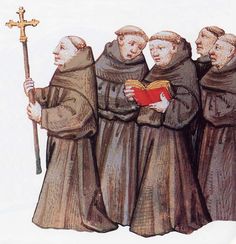
monks
If the growth of The West and The European Miracle began in the Middle Ages then something in the Middle Ages must have caused that. So what about western Europe was unique enough to merit attention? The existence of the Catholic Church; a powerful international church that had it’s own interests which were often contrary to the interests of the secular rulers. This state of affairs acted as a check and balance against tyrannical rulers.
During the rise of Europe there was actual separation and Church and State as in that the two were not one in the same. This was in direct contrast to virtually every other human civilization and even the Late Roman Empire, where the Emperors themselves were gods.
The monasteries also preserved a lot of the old knowledge and writing of the Classical world and would later found the first universities.
I’m not going to go too deep into Christian theology here because mostly I don’t have to. Aspects of the Christian faith are found through Western society, cultures and thought. Why even modern secular atheism is nothing but Christianity heresy if you stop to think about it.
I do find it somewhat interesting that a small but noticeable number of Alt-Right men have converted to Catholicism. Food for thought if nothing else.
The Customs of the Germanic Barbarians
KingClovis.jpg
The third pillar of The West and the one that is most difficult to precisely draw a picture of are the customs of the Germanic Tribes; who had very different customs than the conquered and subjugated peoples of the former Roman Empire. Sadly these tribes did not always leave good records (they were barbarians) and trying to study them is often an exercise in frustration.
Still tribes such a the Franks, the Lombards and the Saxons gave their traditions and national character to the emerging Europe and their names to geographic regions. Subtly some of these ridiculous customs linger even until today.
The right to bare arms for example comes from the barbarian custom that owning arms was the sign of a freeman and that at a tribal meeting the men of the tribe would signal their agreement with the chieftain or speaker by clashing their arms together. This became a settled right among the Anglo-Saxon people.
Were they Pagans? Vicious blood thirsty Heathens. Of course! At least at the start of Europe’s formation. The process of creating The West involved slowly converting those tribes into the Christian faith and into the growing civilization spreading across the continent.
The Celts (who weren’t really Germanic) converted very quickly to Catholicism since the new faith almost perfectly fit their cultural needs. Other tribes and barbarians however needed a great deal of persuading; usually of the sharp pointy metal variety before entering into the communion of Rome. Charlemagne was an especially good persuader, in that regard.
What about the Norse? Where do they fit in? Well the Norse were just another set of Germanic tribes, among the last to convert to Christianity. They simply put up one hell of a fight before they did so. We also have better accounts of the Norse customs and beliefs because they were among the last of the Pagans and therefore there was a more developed Europe to chronicle their deeds, or rather their misdeeds. The Viking Age ended once the overwhelm majority of Scandinavians considered themselves Christians but it did make for a couple of exciting centuries.
vikingship3.jpg
Besides the Norse are just fun to study since they were an uncompromisingly masculine culture.
(Come to think of it, so were the Romans at the height of their power.)
Quick reaction to that Reason article and Vox’s Day’s response.
I was about halfway done writing this article (yes I’m a very slow writer) when I run across a Reason.com article on how Donald Trump is against western civilization and also Vox Day’s rather scalding response. Since I’m writing this article from a right-libertarian point of view, I suppose throwing in my two cents on this is a worthwhile endeavour.
Reason Article on how Trump is against Western Civilization by Robby Soave
http://reason.com/blog/2016/04/06/the-alt-right-is-wrong-trump-is-an-enemy
Vox Day’s Response:
http://voxday.blogspot.ca/2016/04/thus-proving-alt-right-right.html
Classical Liberalism is an end result of western civilization not a root cause of it.
As Vox points out there is a matter of centuries between the establishment of western civilization and the rise of Classical Liberalism. I count six or seven centuries between the founding of The West and the first serious writings in the Classical Liberal school of thought. Now I’m a huge fan of Libertarian thinking but I consider liberty to be a universal human value so the questions remains. Why Europe? Why only Europe? Again it was the conditions in western and central Europe that allowed commerce and liberty to flourish.
Western Civilization has at least a 1100 year history; if you only take into account the last two of three centuries (like Mr Soave is) you’re missing out on an enormous part of that history and legacy.
The importance of the Renaissance and the Enlightenment gets vastly overblown by people like Mr. Soave who cannot grasp that the Middle Ages were not the Dark Ages and therefore find themselves having to completely disregard all human history before Adam Smith.
Besides any fan of science fiction author David Weber knows that the industrial revolution actually began in the Middle Ages using waterwheels.
To recap
-The West was fully formed by about 900-950 AD.
-The European Miracle of long term economic growth begins in the Late Middle Ages. Roughly 1300 AD (Long before the timeline suggested by Mr. Soave.)
-The Renaissance was not that interesting (unless you like paintings.)
-Continued economic growth over the centuries lead to the formation of a tax paying middle class.
-That middle class began to demand their political rights.
-Therefore the Enlightenment and rise of Classical Liberalism was a direct result of the Middle Ages.
Horse first, then cart.
Thoughts on Trump
I am not a cheerful supporter of Donald Trump. However the night is dark, the hour is late and it is important to consider all options.
War is the health of the State. Therefore the primary concern of the libertarian activist is to avoid, prevent, or deescalate violent conflict. Intentionally losing a conflict however is not a requirement of Classical Liberal thought. Donald Trump’s ‘isolationist’ policies buys America time to recover from the disasters of the War on Terrorism and gets The West a reprieve, a chance to rediscover itself and push back the cultural Marxist hordes.
There is no true antiwar candidate in the current US presidential race but Donald Trump is the ‘less war” candidate. He is the least likely candidate to get America into another series of wars of choice or push Russia and China into a permanent anti-American Alliance. That ALONE should get him the libertarian vote!
If Walter “Freaking” Block is willing to support Donald Trump then I’m a little confused as to how anyone at Reason could oppose Trump on purely libertarian grounds.
History and The Struggle for Liberty: Part One
https://mises.org/library/1-european-miracle
This is part one of a ten part audio lecture by historian Ralph Raico (From 2004.) This lecture series appears to be where I got many of the concepts that form the core of this article. While the enjoyment of the whole series may be subject to taste I highly recommend part one.
Update: In reaction to the Apr 6th Robby Soave article I would definitely recommend the listening to at least first two parts of this lecture series if you can find or make time do so.

Thursday, March 17, 2016

Did Africans Sell Africans Into Slavery? Let’s Ask Some Africans

 From Taki's Magazine. Article by Jim Goad

Did Africans Sell Africans Into Slavery? Let’s Ask Some Africans

March 07, 2016
 
Did Africans Sell Africans Into Slavery? Let’s Ask Some Africans
If there is a historical weapon more powerful and decisive than guns, it is certainly guilt. Those who seek to conquer will wield the primitive biblical notion of collective guilt as a bludgeon to dampen a rival group’s spirit and their willingness to resist. Guilt is injected like a fatal virus into entire populations to demoralize and weaken them. And at least as far as whites in the West are concerned, it is working like a charm.
Without so much as asking a single question, many modern whites have gullibly swallowed a skewed and incomplete historical narrative that depicts them as history’s sole villains and the nonwhite world as innocent, suffering lambs.
Alas, despite the cheering warmth such simplicities afford to simple minds, life is never that simple, and as any honest student of history knows, there is no such thing as “good guys”—there are only bad guys who won and bad guys who lost.
Whenever I note that when it comes to the emotionally hypersensitive topic of slavery, there is more than enough historical guilt to go around and that slavery’s history cannot neatly be boxed into binary struggles of good versus evil or black versus white, I am invariably accused of trying to alleviate or deny the guilt that we are ceaselessly lectured whites should constantly be torturing ourselves with.
“If there is a historical weapon more powerful and decisive than guns, it is certainly guilt.”
If one dares to point out that Africans were vastly complicit in the African slave trade, one is accused of trying to “deny” white guilt or to “absolve” whites of guilt, or of trying to argue that “two wrongs make a right.”
No, dummies. Two wrongs make two wrongs. But the question is: Why do you focus only on one wrong? It would seem that in all cases, the ones who are truly trying to “deny” guilt or “absolve” themselves of it are the ones who insist everyone focus merely on one wrong rather than all of them. Humanity, regardless of color, will never suffer a shortage of guilt.
Many black apologists and their white enablers will outright deny that Africans sold Africans into slavery. The always interesting Nation of Islam argues that these treacherous go-betweens weren’t truly “African” anyway—they were instead Portuguese Jewish half-breeds known as lancados who’d deliberately interbred with indigenous Africans in order to swindle and kidnap them before handing them over to Jewish slave traders who’d shlep them to the Americas.
To many others for whom the overwhelming evidence of African collaboration in the slave trade becomes impossible to deny, they’ll leap through flaming poodle hoops trying to make excuses. They’ll allege that African slavery was more benign than all other forms…or that Africans who sold other Africans to Islamic and European slavers had no idea how brutally the victims would be treated…or that they didn’t consider one another “black” but rather enemies from warring tribes, as if that makes it any better ethically…or that it was only a handful of African Judases and Uncle Toms who sold their continental kin into New World bondage and was not in any way an established, officially mandated, and integral part of several sub-Saharan economies.
Nearly all modern historians agree that the scenario depicted by Alex Haley in Roots—that of white raiders penetrating the African interior to rout African villages for slaves—is fraudulent. Instead, European slave traders nearly always bought slaves from African vendors at coastal markets. We hear much about the brutal “Middle Passage” across the Atlantic Ocean, but almost never about the estimated 10 million or so indigenous Africans who perished while being marched to the sea in chains and yokes by their African captors.
We don’t hear that according to Boston University’s Linda Heywood and John Thornton, about 90% of Africans transported to the New World had initially been enslaved by other Africans. We don’t hear about Tippu Tip, who was once a world-famous black slave trader in Zanzibar. And we certainly don’t hear much about how Barack Obama—who has no ancestral ties to African slaves in America—is descended from the Luo peoples, who routinely captured other Africans in war and sold them into slavery.
But when the Transatlantic Slave Trade was still active, what did African blacks and their American descendants have to say? Glad you asked:
“…I must own, to the shame of my own countrymen, that I was first kidnapped and betrayed by some of my own complexion, who were the first cause of my exile and slavery…If there were no buyers there would be no sellers.”
—African abolitionist Ottobah Cugoano (1757-1791)
“The savage chiefs of the western coasts of Africa, who for ages have been accustomed to selling their captives into bondage and pocketing the ready cash for them, will not more readily accept our moral and economical ideas than the slave traders of Maryland and Virginia….We are, therefore, less inclined to go to Africa to work against the slave trade than to stay here to work against it.”
—Frederick Douglass
And here’s what several prominent modern African leaders have to say about the subject:
“African chiefs were the ones waging war on each other and capturing their own people and selling them. If anyone should apologize, it should be the African chiefs. We still have those traitors here even today.”
—Ugandan President Yoweri Museveni, 1998
“I want to apologize for the role my ancestors played in the slave trade….I knew one day I wanted to come to this land and ask forgiveness of my black brothers and sisters. I wanted to cross the ocean to see the land where my ancestors suffered.”
—King Kpoto-Zounme Hakpon III of Benin to a black audience in Alabama, 2013
“We cannot continue to blame the white men, as Africans, particularly the traditional rulers, are not blameless….In view of the fact that the Americans and Europe have accepted the cruelty of their roles and have forcefully apologised, it would be logical, reasonable and humbling if African traditional rulers…[can] accept blame and formally apologise to the descendants of the victims of their collaborative and exploitative slave trade.”
—Civil Rights Congress of Nigeria, 2009
“I believe there is a great psychic shadow over Africa, and it has much to do with our guilt and denial of our role in the slave trade. We too are blameworthy in what was essentially one of the most heinous crimes in human history.”
—Former Ghanaian diplomat to the UN Kofi Awoonor, 1994
I have endlessly more respect for modern African leaders who are willing to acknowledge their ancestors’ role in slavery than I do for modern ethno-masochistic whites that try, against all evidence, to isolate guilt only on the white side and smear all whites from here to eternity with the invisible shit stain of guilt. I also have far more respect for these African leaders than I do any modern American blacks who blame whites, and only whites, for every last drop of black suffering.
If I feel a kinship with anyone, it is with those who are intelligent and noble enough to acknowledge that history is unbearably complex and is more reasonably viewed as a power struggle between winners and losers rather than good guys and bad guys. In the end, only morons strain to justify historical events, while wise men merely try to understand them.

Please share this article by using the link below. When you cut and paste an article, Taki's Magazine misses out on traffic, and our writers don't get paid for their work. Email editors@takimag.com to buy additional rights. http://takimag.com/article/did_africans_sell_africans_into_slavery_lets_ask_some_africans_jim_goad/print#ixzz43AIVPGTH

Tuesday, March 15, 2016

Lysander Spooner: The Abolitionist Seccessionist (Abbeville Institute / Review)

FROM: Abbeville Institute The Abbeville Review

The Abolitionist Secessionist?


spooner
“To live honestly is to hurt no one, and give to every one his due.”-Lysander Spooner
Lysander Spooner was a Boston legal scholar and philosopher during the nineteenth century. What makes this man of Massachusetts valuable to the legacy of the Southern tradition is that Spooner was a consistent proponent of Jeffersonian Classical Liberalism*. There are two characteristics that are the most prominent to Lysander Spooner and his works. The first is his strong individualist personality. The second is his uncompromising dedication to the use of reason and evidence in the formation of his conclusions. Spooner would never shy from controversy in the name of defending morals or logic, and this dedication makes his works stimulating and often enjoyable for anyone of any degree of interest in studying them. Lysander Spooner was indeed a great philosopher and scholar both in his and our time.
Spooner published writings on nearly every subject, from economics, to religion, to copyright law. He even set out on an entrepreneurial venture of a private mail company to compete with the United States Post Office. To chronicle Spooner’s career in its entirety is beyond the scope of this work. This work will focus on two of Spooner’s positions, his position on slavery and his position on the war between the North and South.
Lysander Spooner was an abolitionist, but he was unique amongst other opponents of slavery in the North. Spooner didn’t believe that extra-legal or violent measures were necessary to end slavery. Instead he turned one of slavery’s biggest defenses against itself. Slavery was often claimed to be protected under the Constitution, leading to fiery activists like William Lloyd Garrison to claim that the Constitution was a “covenant with death” and an “agreement with Hell”. Spooner disagreed with such sentiment and wrote a detailed essay in 1840 titled The Unconstitutionality of Slavery where he uses his characteristically analytical legal interpretation to prove by peaceful and lawful means that slavery should be done away with. It has even been reported that after reading Spooner’s arguments, Frederick Douglas changed his views on the Constitution from those of Garrison to be in agreement with Spooner. The arguments Spooner makes are (in brief summary) that the Constitution must be read literally, and that arguments based upon hidden intent or implication on the part of the Founding Fathers’ words were illegitimate; from this principle, Spooner argued that since slavery wasn’t explicitly protected under the Constitution it couldn’t be defended as if it were. Spooner also claimed that because the Constitution was designed for the defense of human liberty, it could be argued that if it had to be used in a debate regarding slavery; it could only be used against the institution. Spooner would perform a similar analysis of the Constitution decades later (this will be explained later on). It is important to note that the literal interpretation of the words of the Constitution was championed by Thomas Jefferson, as opposed to Alexander Hamilton’s theory that the Constitution had implied powers that could be inferred almost arbitrarily by any politician who happens to interpret the document in a specific manner.
Like other abolitionists, Spooner disagreed with the Fugitive Slave Act, and would attempt to provide lawyers with legal loopholes in the law to help protect escaped slaves from being returned to their owners.  Spooner did deviate from his desire for peaceful abolition when he supported John Brown’s raid on Harper’s Ferry. Spooner even went as far as to propose a plan for abolitionists to kidnap the governor of Virginia, in order to facilitate a prisoner exchange for Brown. The plan for an uprising against the slave owners  was of course, never executed, but it is evidence of one of the periods of Spooner’s life where his intellectual prowess led him to frustration and arguably even desperation with the people of his time. It is also important to note, that Spooner consistently emphasized the importance of appealing to the non-slave owners in the South in order to foster friendship, and to detach abolitionist ideals from their perception as being geographic antagonism.
There is no question of Spooner’s dedication to the abolitionist cause, a moral crusade that he defended with the utmost zeal and determination. Due to this, it will probably surprise many readers that on the outset of the War Between the States, Spooner defended the Confederate States of America. In much contrast to other abolitionists and war hawks in the North, Spooner despised the Republican Party, and the Union war effort. He argued that the war wasn’t over slavery, but for the Northern politicians to maintain an illegitimate dominion over the South. He openly criticized the members of the Republican party before and during the war. In a letter to William H. Seward dated in 1860, he recounts that Senator Albert Brown of Mississippi reacted to The Unconstitutionality of Slavery by saying, “the book is ingeniously written. No mere simpleton could ever have drawn such an argument. If his premises were admitted, I should say at once that it would take a Herculean task to overthrow his argument.” Spooner, attacking the Republican’s desire to protect slavery while attempting to gain abolitionist social support, gives Seward this statement; “Thus an open advocate of slavery from Mississippi, virtually makes more concessions to the antislavery character of the constitution, than a professed advocate of liberty, from New York…” Spooner also stated that the Republicans were “double­faced demagogues” and that he desired to “embarrass” their plans to “ride into power on the two horses of Liberty and Slavery”.  In 1864 Spooner wrote a letter to Charles Sumner where he challenges him on the same point. He criticizes Sumner as being a concessioner for slavery, while boasting of being in favor of abolition. He even cites a conversation that was reported to him by an associate of his where Sumner claimed that Spooner’s arguments put forth in The Unconstitutionality of Slavery were correct. But since Sumner never attacked slavery on a constitutional basis, and favored making war with the South, Spooner, in this letter calls him a “deliberately perjured traitor to the constitution, to liberty, and to truth.” He also states that the Republican’s refusal to attack slavery through constitutional arguments “placed the North wholly in the wrong, and the South wholly in the right.” Spooner, despite his temporary support for John Brown, had believed that violence was not necessary to abolish slavery (especially violence against non-slaveholders which comprised the majority of the Confederate population!). Spooner thunders upon Sumner and all of history with this sentence; ”You, and others like you have done more, according to your abilities, to prevent the peaceful abolition of slavery, than any other men in the nation…”. Spooner’s letters to Sumner and Seward offer an important perspective for anyone interested in the Jeffersonian tradition in American history as well as an abolitionist perspective on the role of slavery in the War Between the States. The letters show not just hypocrites in American politics, but a also a man whose dedication to truth transcended the comfort of social convenience, and popular politics.
Lysander Spooner’s quest for justice was far from finished. In the years after the war, Spooner wrote a series of essays that offered a methodical analysis of the current nature of the United States Constitution, and of the Union that had supposedly been preserved. There were six essays, but essays three through five are now lost to history, the titles that we have now are; No Treason (1), No Treason: The Constitution (2), and No Treason: The Constitution of No Authority (6). These essays are perhaps the finest examples of Jeffersonianism in Spooner’s work. A few summaries are necessary to emphasize this point.
The first essay offers a critique of the Northern point of view for the war. The essay is as scathing as his words to the previously mentioned Republican senators. For example, he contested the proclamation that the Union saved the idea of voluntary government and self-determination, a claim that was championed by Abraham Lincoln himself in his Gettysburg Address. Spooner wrote in No Treason,  “the late war has practically demonstrated that our government rests upon force – as much so as any government that ever existed.” and “In proportion to her wealth and population, the North has probably expended more money and blood to maintain her power over an unwilling people, than any other government ever did.” The general theme of Spooner’s argument in this essay is, that a government of consent necessarily means the consent of every individual human being that is to live under that government is required for that government to be called voluntary and free and that it is the right of every individual to terminate any voluntary association with each other if they have the desire to do so. This principle could extend to individuals acting in concert i.e., States seceding from the Union.  He concludes this essay with, “…the principle of individual consent, the little government that mankind need, is not only practicable, but natural and easy; and that the Constitution of the United States authorizes no government, except one depending wholly on voluntary support.”
This conclusion to the first essay is expanded upon in the second essay. In this piece, Spooner provides arguments that conclude that the Constitution and the government it prescribes are only valid and just if it depends exclusively upon voluntary support. He prefaces his argument by describing the preamble to the Constitution in this way, “The meaning of this is simply We, the people of the United States, acting freely and voluntarily as individuals, consent and agree that we will cooperate with each other in sustaining such a government as is provided for in this Constitution.” He chooses to emphasize the idea that individuals, not the States, ratified the Constitution, with the purpose of saying that even if this were the case, the Lincolnian argument still is invalid and unjust even if it is conceded that the Constitution wasn’t ratified by the States. He argues that, “Any one man, or any number of men, have had a perfect right, at any time, to refuse his or their further support; and nobody could rightfully object to his or their withdrawal.” Thus, he argues that secession or dissolution is an intrinsic human right. Spooner, also validates the Southern argument though, he follows up the previous quote with this statement, “On the other hand, if we say that the adoption was the act of the States, as States, it necessarily follows that they had the right to secede at pleasure….” Furthermore, Spooner argued in this essay that Southerners were innocent of treason against the United States, and he compared them with the American revolutionaries of 1776.
The sixth essay entitled, No Treason: The Constitution of No Authority is the longest and hardest hitting essay. He spends nearly the first half of the essay making arguments as to how the Union had become illegitimate. He even includes a legal argument for those who served as Confederate soldiers designed to help them exempt themselves from oaths pledging loyalty to the federal government. This is in striking similarity to his work in finding legal loopholes in the Fugitive Slave Act decades earlier. This and other arguments that he wrote in this series of essays were published in Southern magazines, like De Bow’s Review. Spooner’s arguments regarding the Union, and government itself, are intricate and complex in scale and substance, and will not be discussed further here. What will be emphasized is the second half of the essay, which elaborates upon what Spooner argued, was the true nature of the War Between the States. Spooner explicitly states that, “The pretense that the “abolition of slavery” was either a motive or justification for the war, is a fraud…” He declares that the Union was motivated solely to exploit the Southern economy for the benefit of the corrupt Northern businesses that were the real power behind the Republican Party. Spooner argues that slavery could have been abolished peacefully, the war could have been prevented and, “a thousand times nobler union than we have ever had would have been the result.” If the abolitionist, Lysander Spooner’s support for Southerners was ever in doubt before, one could be satisfied with his final barrage against the Northern view of the war, “All these cries of having “abolished slavery,” of having “saved the country,” of having “preserved the union,” of establishing “a government of consent,” and of “maintaining the national honor,” are all gross, shameless, transparent cheats – so transparent that they ought to deceive no one – when uttered as justifications for the war, or for the government that has succeeded the war, or for now compelling the people to pay the cost of the war, or for compelling anybody to support a government that he does not want.”
Lysander Spooner was a forcible personality in his own time. But his influence is still felt today, most prominently amongst modern Libertarians like Tom Woods (author of The Politically Incorrect Guide to American History). His essay, The Unconstitutionality of Slavery was cited in the, District of Columbia v. Heller Supreme Court case as evidence in favor of preventing the ban of handguns. Spooner offers an important perspective for those who want to understand Southern history and the history of the War Between the States. The nature of the philosophy he advocated also serves to prove the universality of many of the principle that are held by the Southern Tradition. Considering just these examples from a lifelong career of Spooner’s battles for advancing freedom, it is no mystery as to why his gravestone in Massachusetts bears the title, “Champion of Liberty”.
*Lysander Spooner never explicitly gave a name to any ideology that he purported, only citing Natural Law and universal principles in his works, but these universal principles and axioms, namely those of individual rights, property rights, and self-determination are all integral to Jeffersonian thought. In addition to this, a man named Benjamin Tucker, a close associate of Spooner, identified the principles that he and Spooner advocated for as “unterrified Jeffersonianism.”
Sources:
No Treason: The Constitution of No Authority
http://static1.squarespace.com/static/55a3c833e4b07c31913e6eae/t/55a90c38e4b0865180f14a45/1437142072769/NO+TREASON.n6.pdf
No Treason: The Constitution
http://static1.squarespace.com/static/55a3c833e4b07c31913e6eae/t/55a90c2de4b0865180f14a12/1437142061276/NO+TREASON.n2.pdf
No Treason
http://static1.squarespace.com/static/55a3c833e4b07c31913e6eae/t/55a90c20e4b0865180f149d5/1437142048361/NO+TREASON.n1.pdf
Spooner’s Letter to Sumner
http://static1.squarespace.com/static/55a3c833e4b07c31913e6eae/t/55a5263fe4b0c83122fb55c4/1436886591736/Letter+to+Charles+Sumner.pdf
Spooner’s Letter to Seward
http://static1.squarespace.com/static/55a3c833e4b07c31913e6eae/t/55a51643e4b0ada672912c84/1436882499285/SESP012260.pdf
Wikipedia entry for Lysander Spooner
https://en.wikipedia.org/wiki/Lysander_Spooner#cite_note-25
Lysander Spooner Biography
http://www.lysanderspooner.org/biopgraphy/


About Matt De Santi

Matt De Santi is a high school senior in California interested in the Southern tradition. More from Matt De Santi

Wednesday, March 9, 2016

Why The War Was Not About Slavery

Why The War Was Not About Slavery


lost cause 2
Conventional wisdom of the moment tells us that the great war of 1861—1865 was “about” slavery or was “caused by” slavery. I submit that this is not a historical judgment but a political slogan. What a war is about has many answers according to the varied perspectives of different participants and of those who come after. To limit so vast an event as that war to one cause is to show contempt for the complexities of history as a quest for the understanding of human action.
Two generations ago, the most perceptive historians, much more learned than the current crop, said that the war was “about” economics and was “caused by” economic rivalry. The war has not changed one bit since then. The perspective has changed. It can change again as long as people have the freedom to think about the past. History is not a mathematical calculation or scientific experiment but a vast drama of which there is always more to be learned.
I was much struck by Barbara Marthal’s insistence in her Stone Mountain talk on the importance of stories in understanding history. I entirely concur. History is the experience of human beings. History is a story and a story is somebody’s story. It tells us about who people are. History is not a political ideological slogan like “about slavery.” Ideological slogans are accusations and instruments of conflict and domination. Stories are instruments of understanding and peace.
Let’s consider the war and slavery. Again and again I encounter people who say that the South Carolina secession ordinance mentions the defense of slavery and that one fact proves beyond argument that the war was caused by slavery. The first States to secede did mention a threat to slavery as a motive for secession. They also mentioned decades of economic exploitation and the seizure of the common government for the first time ever by a sectional party declaredly hostile to the Southern States. Were they to be a permanently exploited minority, they asked? This was significant to people who knew that their fathers and grandfathers had founded the Union for the protection and benefit of ALL the States.
It is no surprise that they mentioned potential interference with slavery as a threat to their everyday life and their social structure. Only a few months before, John Brown and his followers had attempted just that. They murdered a number of people including a free black man who was a respected member of the Harpers Ferry community and a grand-nephew of George Washington because Brown wanted Washington’s sword as a talisman. In Brown’s baggage was a constitution making him dictator of a new black nation and a supply of pikes to be used to stab to death the slave-owner and his wife and children.
It is significant that not one single slave joined Brown’s attempted blow against slavery. It was entirely an affair of outsiders. Significant also is that six Northern rich men financed Brown and that some elements of the North celebrated him as a saint, an agent of God, ringing the church bells at his execution. Even more significantly, Brown was merely acting out the venomous hatred of Southerners that had characterized some parts of Northern society for many years previously.
Could this relentless barrage of hatred directed by Northerners against their Southern fellow citizens have perhaps had something to do with the secession impulse? That was the opinion of Horatio Seymour, Democratic governor of New York. In a public address he pointed to the enormity of making war on Southern fellow citizens who had always been exceptionally loyal Americans, but who had been driven to secession by New England fanaticism.
Secessionists were well aware that slavery was under no immediate threat within the Union. Indeed, some anti-secessionists, especially those with the largest investment in slave property, argued that slavery was safer under the Union than in a new experiment in government.
Advocates of the “slavery and nothing but slavery” interpretation also like to mention a speech in which Confederate Vice-President Alexander Stephens is supposed to have said that white supremacy was the “cornerstone” of the Confederacy. The speech was ad hoc and badly reported, but so what? White supremacy was also the cornerstone of the United States. A law of the first Congress established that only white people could be naturalized as citizens. Abraham Lincoln’s Illinois forbade black people to enter the State and deprived those who were there of citizenship rights.
Instead of quoting two cherry-picked quotations, serious historians will look into more of the vast documentation of the time. For instance, in determining what the war was “about,” why not consider Jefferson Davis’s inaugural address, the resolutions of the Confederate Congress, numerous speeches by Southern spokesmen of the time as they explained their departure from the U.S. Congress and spoke to their constituents about the necessity of secession. Or for that matter look at the entire texts of the secession documents.
Our advocates of slavery causation practice the same superficial and deceitful tactics in viewing their side of the fight. They rely mostly on a few pretty phrases from a few of Lincoln’s prettier speeches to account for the winning side in the Great Civil War. But what were Northerners really saying?
I am going to do something radical. I am going to review what Northerners had to say about the war. Not a single Southern source, Southern opinion, or Southern accusation will I present. Just the words of Northerners (and a few foreign observers) on what the war was “about.”
Abraham Lincoln was at pains to assure the South that he intended no threat to slavery. He said he understood Southerners and that Northerners would be exactly like them living in the same circumstances. He said that while slavery was not a good thing (which most Southerners agreed with) he had no power to interfere with slavery and would not know what to do if he had the power. He acquiesced in a proposed 13th Amendment that would have guaranteed slavery into the 20th century. Later, he famously told Horace Greeley that his purpose was to save the Union, for which he would free all the slaves, some of the slaves, or none of the slaves. The Emancipation Proclamation itself promised a continuance of slavery to States that would lay down their arms.
All Lincoln wanted was to prevent slavery in any territories, future States, which then might become Southern and vote against Northern control of the Treasury and federal legislation. From the anti-slavery perspective this is a highly immoral position. At the time of the Missouri Compromise, Thomas Jefferson and James Madison said that restricting the spread of slavery was a false, politically motivated position. The best thing for the welfare of African Americans and their eventual emancipation was to allow them to spread as thinly as possible.
Delegation after delegation came to Lincoln in early days to beg him to do something to avoid war. Remember that 61% of the American people had voted against this great hero of democracy, which ought to have led him to a conciliatory frame of mind. He invariably replied that he could not do without “his revenue.” He said nary a word about slavery. Most of “his revenue” was collected at the Southern ports because of the tariff to protect Northern industry and most of it was spent in the North. Lincoln could not do without that revenue and vowed his determination to collect it without interruption by secession. He knew that his political backing rested largely on New England/New York money men and the rising power of the new industrialists of Cleveland, Detroit, and Chicago who were aggressively demanding that the federal government sponsor and support them. The revenue also provided the patronage of offices and contracts for his hungry supporters, without which his party would dwindle away.
Discussing the reaction to secession, the New York Times editorialized: “The commercial bearing of the question has acted upon the North. We were divided and confused until our pockets were touched.” A Manchester, N.H., paper was one of hundreds of others that agreed, saying: “It is very clear that the South gains by this process and we lose. No, we must not let the South go.”
Meanwhile, the U.S. Congress officially declared that the war WAS NOT AGAINST SLAVERY but to preserve the Union. (By preserving the Union, of course, they actually meant not preserving the real Union but ensuring their control of the federal machinery.)
At the Hampton Roads peace conference a few months before Appomattox, Lincoln suggested to the Confederate representatives that if they ceased fighting then the Emancipation Proclamation could be left to the courts to survive or fall. Alexander Stephens, unlike Lincoln, really cared about the fate of the black people and asked Lincoln what was to become of them if freed in their present unlettered and propertyless condition. Lincoln’s reply: “Root, hog, or die.” A line from a minstrel song suggesting that they should survive as best they could. Lincoln routinely used the N-word all his life, as did most Northerners.
A statement in which Lincoln is said to favour voting rights for black men who were educated or had been soldiers has been shown to be fraudulent. Within a few days of his death he was still speaking of colonization outside the U.S.
The South, supposedly fighting for slavery, did not respond to any of these offers for the continuance of slavery. In fact, wise Southerners like Jefferson Davis realized that if war came it would likely disrupt slavery as it had during the first war of independence. That did not in the least alter his desire for the independence and self-government that was the birthright of Americans. Late in the war he sent a special emissary to offer emancipation if European powers would break the illegal blockade.
Saying that the South was fighting only to defend the evils of slavery is a deceitful back-handed way to suggest that, therefore the North was fighting to rid America of the evils of slavery. Nothing could be further from the truth. First of all, secession did not necessarily require war against the South. That was a choice. Slavery had existed for over two hundred years and there was no Northern majority in favour of emancipation. Emancipation was not the result of a moral crusade against evil but a byproduct of a ruthless war of invasion and conquest. Not one single act of Lincoln and the North in the war was motivated by moral considerations in regard to slavery.
Even if slavery was a reason for secession, it does not explain why the North made a war of invasion and conquest on a people who only wanted to be let alone to live as they had always lived. The question of why the North made war is not even asked by our current historians. They assume without examination that the North is always right and the South is always evil. They do not look at the abundant Northern evidence that might shed light on the matter.
When we speak about the causes of war should we not pay some attention to the motives of the attacker and not blame everything on the people who were attacked and conquered? To say that the war was “caused” by the South’s defense of slavery is logically comparable to the assertion that World War II was caused by Poland resisting attack by Germany. People who think this way harbor an unacknowledged assumption: Southerners are not fellow citizens deserving of tolerance but bad people and deserve to be conquered. The South and its people are the property of the North to do with as they wish. Therefore no other justification is needed. That Leninist attitude is very much still alive judging by the abuse I receive in print and by e-mail. The abuse never discusses evidence, only denounces what is called “Neo-Confederate” and “Lost Cause” mythology. These are both political terms of abuse that have no real meaning and are designed to silence your enemy unheard.
Let us look at the U.S. Senate in February 1863. Senator John Sherman of Ohio, one of the most prominent of the Republican supporters of war against the South, has the floor. He is arguing in favour of a bill to establish a system of national banks and national bank currency. He declared that this bill was the most important business pending before the country. It was so important, he said, that he would see all the slaves remain slaves if it could be passed. Let me repeat this. He would rather leave all the slaves in bondage rather than lose the national bank bill. This was a few weeks after the issuing of the Emancipation Proclamation.
What about this bill? Don’t be deceived by the terminology. So-called National Banks were to be the property of favoured groups of private capitalists. They were to have as capital interest-bearing government bonds at a 50% discount. The bank notes that they were to issue were to be the national currency. The banks, not the government, had control of this currency. That is, these favoured capitalists had the immense power and profit of controlling the money and credit of the country. Crony capitalism that has been the main feature of the American regime up to this very moment.
Senator Sherman’s brother, General Sherman, had recently been working his way across Mississippi, not fighting armed enemies but destroying the infrastructure and the food and housing of white women and children and black people. When the houses are burned, the livestock taken away or killed, the barns with tools and seed crops destroyed, fences torn down, stored food and standing crops destroyed, the black people will starve as well as the whites. General Sherman was heard to say: “Damn the niggers! I wish they were anywhere but here and could be kept at work.”
General Sherman was not fighting for the emancipation of black people. He was a proto-fascist who wanted to crush citizens who had the gall to disobey the government.
The gracious Mrs. General Sherman agreed. She wrote her husband thus:
“I hope this may not be a war of emancipation but of extermination, & that all under the influence of the foul fiend may be driven like swine into the sea. May we carry fire and sword into their states till not one habitation is left standing.”
Not a word about the slaves.
As the war began, the famous abolitionist Theodore Weld declared that the South had to be wiped out because it is “the foe to Northern industry—to our mines, our manufactures, our commerce.” Nothing said about benefit to the slaves. The famous abolitionist Henry Ward Beecher enjoyed a European tour while the rivers of blood were flowing in America. Asked by a British audience why the North did not simply let the South go, Beecher replied, “Why not let the South go? O that the South would go! But then they must leave us their lands.”
Then there is the Massachusetts Colonel who wrote his governor from the South in January 1862:
“The thing we seek is permanent dominion. . . . They think we mean to take their slaves? Bah! We must take their ports, their mines, their water power, the very soil they plow . . . .”
Seizing Southern resources was a common theme among advocates of the Union. Southerners were not fellow citizens of a nation. They were obstacles to be disposed of so Yankees could use their resources to suit themselves. The imperialist impulse was nakedly and unashamedly expressed before, during, and after the war.
Charles Dickens, who had spent much time in the U.S. a few years before the war, told readers of his monthly magazine in 1862: “The Northern onslaught upon slavery was no more than a piece of specious humbug designed to conceal its desire for economic control of the Southern states.”
Another British observer, John Stuart Mill, hoped the war would be against slavery and was disappointed. “The North, it seems,” Mill wrote, “have no more objections to slavery than the South have.”
Another European thinker to comment was Karl Marx. Like many later Lincoln worshippers, Marx believed that the French Revolution was a continuation of the American Revolution and Lincoln’s revolution in America a continuation of the French. He thought, wrongly, that Lincoln was defending the “labour of the emigrant against the aggressions of the slave driver.” The war, then, is in behalf of the German immigrants who had flooded the Midwest after the 1848 revolutions. Not a word about the slaves themselves. Indeed, it was the numbers and ardent support of these German immigrants that turned the Midwest from Democrat to Republican and elected Lincoln. It would seem that Marx, like Lincoln, wanted the land for WHITE workers.
Governor Joel Parker of New Jersey, a reluctant Democratic supporter of the war, knew what it was all about: “Slavery is no more the cause of this war than gold is the cause of robbery,” he said. Like all Northern opponents and reluctant supporters of Lincoln, he knew the war was about economic domination. As one “Copperhead” editor put it: the war was simply “a murderous crusade for plunder and party power.” “Dealing in confiscated cotton seems to be the prime activity of the army,” he added.
Wall Street agreed and approved. Here is a private circular passed among bankers and brokers in late 1861:
“Slavery is likely to be abolished by the war power and this I and my friends are all in favor of, for slavery is but the owning of labor and carries with it the care of the laborers, while the European plan, led on by England, is that capital shall control labor by controlling wages. The great debt that capitalists will see to it is made out of the war must be used as a means to control the volume of money.”
It is not clear whether this is authentic or a satire, but it tells the truth whichever.
The libertarian Lysander Spooner, an abolitionist, called the Lincoln rule “usurpation and tyranny” that had nothing to do with a moral opposition to slavery. “It has cost this country a million of lives, and the loss of everything that resembles political liberty.”
Here is Frederick Douglass, the most prominent African American of the 19th century:
“It must be admitted, truth compels me to admit . . . Abraham Lincoln was not, in the fullest sense of the word, either our man or our model. In his interests, in his associations, in his habits of thought, and in his prejudices, he was a white man. He was preeminently the white man’s president, entirely devoted to the welfare of white men. He was ready and willing at any time . . . to deny, postpone, and sacrifice the rights of humanity in the colored people to promote the welfare of the white people of his country.”
What better testimony is needed that emancipation was a by-product, not a goal, of a war of conquest. Let me repeat: emancipation was a by-product of the war, never a goal.
How about these curiosities from the greatest of Northern intellectuals, Emerson. He records in his journals: “But the secret, the esoteric of abolition—a secret, too, from the abolitionist—is, that the negro and the negro-holder are really of one party.” And again, “The abolitionist wishes to abolish slavery, but because he wishes to abolish the black man.” Emerson had previously predicted that African Americans were like the Dodo, incapable of surviving without care and doomed to disappear. Another abolitionist, James G. Birney, says: “The negroes are part of the enemy.”
Indeed a staple of Northern discourse was that black people would and should disappear, leaving the field to righteous New England Anglo-Saxons. My friend Howard White remarks: “Whatever his faults regarding slavery, the Southerner never found the existence of Africans in his world per se a scandal. That particular foolishness had its roots in the regions further North.”
In 1866, Boston had a meeting of abolitionists and strong Unionists. The speaker, a clergymen, compared the South to a sewer. It was to be drained of its present inhabitants and “to be filled up with Yankee immigration . . . and upon that foundation would be constructed a new order of things. To be reconstructed, the South must be Northernized, and until that was done, the work of reconstruction could not be accomplished.” Not a word about a role for African Americans in this program.
One of the most important aspects of the elimination of slavery is seldom mentioned. The absence of any care or planning for the future of black Americans. The Russian Czar pointed this out to an American visitor as a flaw that invalidated the fruits of emancipation. We could fill ten books with evidence of Northern mistreatment of black people during and after the war. Emancipation as it occurred was not a happy experience. To borrow Kirkpatrick Sale’s term, it was a Hell. I recommend Kirk’s book Emancipation Hell and Paul Graham’s work When the Yankees Come, which are available here.
I suspect many Americans imagine emancipation as soldiers in blue and freed people rushing into one another’s arms to celebrate the day of Jubilee. As may be proved from thousands of Northern sources, the Union solders’ encounter with the black people of the South was overwhelmingly hate-filled, abusive, and exploitive. This subject is just beginning to be explored seriously. Wrote one Northerner of Sherman’s men, they “are impatient of darkies, and annoyed to see them pampered, petted and spoiled.” Ambrose Bierce, a hard-fighting Union soldier for the entire war, said that the black people he saw were virtual slaves as the concubines and servants of Union officers.
Many black people took to the roads not because of an intangible emancipation but because their homes and living had been destroyed. They collected in camps which had catastrophic rates or mortality. The army asked some Northern governors to take some of these people, at least temporarily. The governors of Massachusetts and Illinois, Lincoln’s most fervid supporters, went ballistic. This was unacceptable. The black people would be uncomfortable in the North and much happier in the South, said the longtime abolitionist Governor Andrew of Massachusetts. Happier in the South than in Massachusetts?
What about those black soldiers in the Northern army, used mainly for labour and forlorn hopes like the Crater? A historian quotes a Northern observer of U.S. Army activities in occupied coastal Carolina in 1864. Generals declared their intention to recruit “every able-bodied male in the department.” Writes the Northern observer: “The atrocious impressments of boys of fourteen and responsible men with large dependent families, and the shooting down of negroes who resisted, were common occurrences.”
The greater number of Southern black people remained at home. They received official notice of freedom not from the U.S. Army but from the master who, when he got home from the Confederate army, gathered the people, told them they were free, and that they must work out a new way of surviving together.
Advocates of the war was “caused by slavery” say that the question has been settled and that any disagreement is from evil and misguided Neo-Confederates deceived by a “Lost Cause” myth.
In fact, no great historical question can ever be closed off by a slogan as long as we are free to think. Howard White and I recently put out a book about the war. Careful, well-supported essays, by 16 serious people. Immediately it appeared on amazon, someone wrote in: “I’m so tired of the Lost Cause writing. Don’t believe the bullshit in this useless pamphlet.” He could not have had time to actually read the book. It can be dismissed unread because he has the righteous cause and we do not. This is not historical debate. It is the propaganda trick of labeling something you do not like in order to control and suppress it. Such are those who want the war to be all about slavery—hateful, disdainful, ignorant, and unwilling to engage in honest discussion.
But if you insist on a short answer solution as to what caused the war I will venture one. The cause of the greatest bloodletting in American history was Yankee greed and hatred. This is infinitely documented before, during, and after the war.
Glory, Glory, Halleluhah


Clyde Wilson is a distinguished Professor Emeritus of History at the University of South Carolina where he was the editor of the multivolume The Papers of John C. Calhoun. He is the M.E. Bradford Distinguished Chair at the Abbeville Institute. He is the author or editor of over thirty books and published over 600 articles, essays and reviews. More from Clyde Wilson

Friday, January 22, 2016

Russia Before the Revolution

From The Thinking Housewife:

Russia Before the Revolution

January 21, 2016

The State Bank of the Russian Empire in Moscow. This building now houses the Central Bank of the Russian Federation.
THE RUSSIAN REVOLUTION took place at a time of remarkable financial stability and progress in the Russian Empire. Russia was the only major power in the world not indebted to central bankers concentrated around the famous Rothschild banks. The Russian government printed the nation’s money, regulated the money supply (unlike the monetary system in America today) and issued low interest loans through commercial banks.
Festival in a Siberian village, c. 1900
In his book, “A History of Central Banking and the Enslavement of Mankind,” (Black House Publishing, 2014) Stephen Mitford Goodson describes the state of Russia before the Bolshevik uprising:
On June 12, 1860 The State Bank of the Russian Empire was founded with the aim of boosting trade turnovers and the strengthening of the monetary system. Up to 1894 it was an auxiliary institution under the direct control of the Ministry of Finance. In that year it was transformed into being the banker of the bankers and operated as an instrument of government’s policy. It minted and printed the nation’s coins and notes, regulated the money supply and through commercial banks provided industry and commerce with low interest rate loans. Its vast gold reserves, the largest in the world, exceeded the bank note issue by more than 100%, except for the year 1906. By 1914 it had become one of the most influential lending institutions in Europe.
Not unexpectedly Russia had the smallest national debt in the world. The following table reflects the number of rubles of debt per inhabitant.
[From table: France: 288.0; Great Britain: 169.8; Germany 135.6; Russia, 58.7]
By 1914 83% of the interest and amortization of the national debt, of which less than 2% was held abroad, was funded by the profits of the Russian State Railways. In 1916 the total length of the main lines was 100,817 verst or kilometers. Russian commercial and canal tonnage of 11,130,000 in 1910 exceeded British merchant tonnage of 10,750,000.
In 1861 Tsar Alexander II (1855-81) abolished serfdom, which at that time affected 30% of the population. By 1914 very little land remained in the possession of the Russian estate owners, who were mainly the nobility. 80% of the arable land was in the hands of the peasants, which had been ceded to them for a very small sum. This land was held in trust by the village commune or mir. However, after the passing of the Stolypin Act in 1906, peasants could obtain individual title with hereditary rights. By 1913, two million families had availed themselves of this opportunity to ac1uire what became known as “Stolypin farms.” Nearly 19,000,000 acres (7,689,027 hectares) were alloted to these individual peasant proprietors by the land committees. The Peasants’ State Bank, which was described at that time as the “greatest and most socially beneficent institution of land credit in the world” granted loans at a low rate of interest, which was in effect a handling charge. Between 1901 and 1912 these loans increased from 222 million rubles to 1,168 billion rubles.
Agricultural production soared so that by 1913, Russia had become the world’s bread basket as the following table reveals. [Not included. The table shows that Russia produced 42 percent of the world’s barley, 67 percent of its rye, 31 percent of its wheat and 30 percent of its oats].
Russian agricultural production of cereals exceeded the combined production of Argentina, Canada and the United States by 25%. In 1913 Russia had 37.5 million horses – more than half of all those in the world. She also produced 80% of the world’s flax and provided more than 50% of the world’s egg imports. Mining and industrial output also expanded by huge margins. Between 1885 and 1913 coal production increased from 259.6 million poods (16.38 kg) to 2,159.8 million poods, cast iron production rose from 25 million poods in 1890 to 1,378 million poods in 1913 and petroleum production rose from 491.2 million poods in 1906 to 602.1 million poods in 1916. From 1870 to 1914 industrial output grew by 1% per annum in Great Britain, 2.75% per annum in the United States and 3.5% per annum in Russia. During the period from 1890 to 1913 industrial production quadrupled and Russian industries were able to satisfy 80% of internal demand for manufactured goods – a perfect example of autarky. Throughout the last 20 years of peacetime imperial rule (1895-1914) the increase in Gross Domestic Product averaged 10% per annum.
With the Russian State bank creating the people’s money out of nothing at almost zero interest; as opposed to the rest of the world where central banks allowed parasitic private banks to create their nation’s money supply at usurious rates of interest, it comes as no surprise to find that in 1912 Russia had the lowest levels of taxation in the world. These very low rates of taxation also attest to the efficiency of the Russian government. Furthermore throughout this period of state banking there was no inflation and no unemployment.
[Table not include. Total tax rate in Great Britain was 26.75 percent per inhabitant, compared to 2.66 percent per inhabitant Russia.]
An independent study by British lawyers concluded that the Russian Code of Laws and judiciary were “the most advanced and impartial in the world.”
Elementary education was obligatory and free right up to university level, where only nominal fees were charged. Between 1906 and 1914 10,000 schools were opened annually. Russian universities were renowned for their high academic standards.
In labor relations the Russians were pioneers. Child labor was abolished over 100 years before it was abolished in Great Britain in 1867. Russia was the first industrialized country to pass laws limiting the hours of work in factories and mines. Strikes, which were forbidden in the Soviet Union, were permitted and minimal in Tsarist times. Trade union rights were recognized in 1906, while an Inspectorate of Labor strictly controlled working conditions in factories. In 1912 social insurance was introduced. Labor laws were so advanced and humane that President William Taft of the United States was moved to say that “the Emperor of Russia has passed workers’ legislation which was nearer to perfection than that of any democratic country.”
The people of all races in the Russian empire had an equality of status and opportunity, which was unparalleled in the modern world. His Imperial majesty Tsar Nicholas II (1894-1917) and his state bank had created a workers’ paradise that was unrivaled in the history of mankind.
On November 7, 1917, the Rothschilds, fearful that replication of this extraordinary example of freedom and prosperity would destroy their malevolent banking empire, instigated and financed a Judeo-Bolshevik revolution in Russia (50), which wrecked and ruined a wonderful country and resulted in the deaths by murder and starvation, according to Alexander Solzhenitsyn, of 66 million innocent people. (51)
[A History of Central Banking and the Enslavement of Mankind, Stephen Mitford Goodson, Black House Publishing, London, 2014; pp. 77-83]

Tuesday, January 5, 2016

HawaiianBioDiversity - Keoni Galt

Another Intstant Classic by the Hawaiian Libertarian

HawaiianBioDiversity


My favorite Southron Paleface called me a pineapple a couple of posts ago that elicited a hearty Laugh Out Loud In teh Real Life from me.

He followed up the with this: "...see, racists can make racist nicknames against each other. in the good ol' days that meant camaraderie!"
Commenter Victor Michaelson weighed in as well: "It reminded me of the America I grew up in, where guys could razz their buddies and it wasn't a Federal offense."
Damn straight you raciss crackers!
We got a special word for you melanin-deficient and solar-sensitive folks here in Hawaii: Haole (pronounced "How-Lee").

From the greatest movie ever filmed in Hawaii
Most folks that have never been to Hawaii, or who have only visited briefly on vacation, have usually only heard of the word haole associated with only negative, racist connotations...the equivalent of the "N-word" for white folks.

That's simply not true. It's a very versatile word and can be used as a simple adjective, a term of endearment or employed as a provocative epithet. As a fair-complexioned (but not totally pale) hapa-haole mutt, I've had the term used on myself in all of these contexts at one time or another. Yet, whenever haole folks come to Hawaii and find themselves being referred by that term, they almost always take immediate offense.
Take this guy for instance:
More haole den haole...
Shua ting, brah, you one human...but you still one haole.
But seriously, let's take a closer look at where this term came from. It's a common myth that the term comes from the Hawaiians who first encountered Captain Cook and his crew's pale faces, they called them Ha'ole, a compound word made from combining Ha- meaning breath, with 'ole meaning without.

This legend is up for debate, as the linguists who study Hawaiian language and the Pidgin English have belabored to dispel the commonly accepted origin. To the credentialed classes, haole is it's own Hawaiian word, and it simply means foreigner:

So if we are to literally go by the textbook, haole really doesn't have anything to do with white skin. In theory, yes, but in practice, no. Thanks to the deluge of immigration from all corners of the globe mixing and miscegenating for a couple of centuries, Hawaii is the so-called ideal "melting pot" our modern day SJW's and progressives say they are supposedly working towards with the rest of the world. In such a chaotic environment of so many different skin tones, hair and eye colors, race is the first way we immediately identify each other, and in that context, haole means white.
I do believe Hawaii is the ideal "melting pot" society....but there are two distinct features about what we have here that makes it much different from the progressive/SJW ideal.
First thing that makes it "work" is we are all race realists, race conscious and racist to the core. It's the only way we can all get along. We don't try to uphold some unrealistic, mystical feeling of holiness attributed to the supposedly ideal paradigm of  "color blindness." In fact, we have the exact opposite. We're more color aware, we're all equal opportunity racists. We LOVE our stereotypes and our racist jokes. At least that was the Hawaii I grew up in. Because of this, we all have similar words like haole that are used to designate all the various races that call our islands home. We got similar words for the Japanese, Chinese, Koreans, Samoans, Micronesians, Filipinos, Puerto Ricans, Vietnamese, and Hispanics. Most of these terms are just like haole - they can serve as simple adjectives or spitefully intended perjoratives. In most cases, you just add the word fuckin' in front, and the harmless adjective turns into hateful, bigoted and racist invective.
Here's a song from the 70's from Hawaiian music's most popular act of that era, the Beamer Brothers. with one of their most popular songs that is still sung and played by musicians at parties and backyard jams everywhere in the islands to this day. In this song, all of the major ethnic groups and their sterotypes regarding their cultural practices and socio-economic status are fair game for good natured-ribbing:

The ending of the song really highlights the main point of this post here:
One thing I when notice 'bout this place
All us guys we tease the other race
It's amazing that we can all live in the same place
I sadly see more and more of the next generation of local folks accepting the progressive SJW mind rot programming of "equality" and "anti-racism," and our common culture is suffering for it. For decades, local stand up comedians made entire careers out of night club routines and television specials making fun of all the races that made up the multi-ethnic society of 20th century Hawaii. There were no sacred cows. We were all fair game...and it had us all laughing our asses off. Yeah, we may have been laughing at you...but then one minute later, it was my turn and you were now laughing at me too. And thus, we were all both laughing at and with each other.
This locally produced tell-a-vision show from 1984 could be considered a good representation of the high point of Hawaii's functionally racist society. It was a childhood favorite of mine, and I was pleasantly surprised to find a clip of it posted on youtube.

In case you didn't figure it out yet, while black folks are "foreigners" they are not haole. We call them Popolos. Hawaiian island/urban legend goes that the first African descendants who came to our shores where of the particular hue that was so dark, the Hawaiians thought they looked purple. The Hawaiian word for purple is popolu...hence popolo. I don't know if it's true or not, but I do know this: just like the word haole, popolo can be used interchangably as mere adjective, a term of endearment, or a race-based slur.
Speaking of stereotypes, we local folk also understand that most popolos that recently arrive from the mainland for are far more sensitive about race than any other race. We have met more than a few black folks that quickly figured out popolo was the Hawaiian word for those of African ancestry, and many immediately equate it with the N-word in significance. Not true though. If we are trying to be deliberately offensive, we'll use the N-word like any other garden variety racist in the world today.
Nevertheless, if we local folks are trying to talk about black people and there may be some within hearing distance when we are conversing who may possibly get offended, we may sometimes say Olopop instead of Popolo (popolo said backwards).
As I mentioned earlier, I was pleasantly surprised to find the preceding clip on youtube, because it is not commercially available anywhere here in 2015. This clip was undoubtedly someone using their smartphone to video clip their VHS or betamax copy of the program. You see, in the last decade or so, our formerly somewhat cooperative society of equal opportunity racism has been infected with the PC mind virus, and the SJW's holy church of blessed colorblindness has caused many folks to scream victimhood at racial humor that was one of our mainstays of local Hawaiian culture of the 20th century. So many of these race-based shows and stand up comedy routines are no longer available or reproduced or re-released anymore, out of fear someone or another will get offended and file a lawsuit to recover damages for their soiled panties or sand filled ass cracks.
That being said, one of the original local comedians from that earlier era of racist harmony still seems to be going at it on youtube, and this clip will give you a pretty good rundown on our history of ethnic diversity and multi-cultural adaptation with regards to linguistics and cultural attitudes of our multi-cult society:

This comedian, Andy Bumatai, was one of the most popular stand up comedians and local tell-a-vision personalities of the 80's. In 2015, this kind of comedy is increasingly coming under fire. Note his disclaimer at the beginning of the clip. Even 5-10 years ago, such a disclaimer would not have been necessary. Times they are a changin'. More and more of the younger generations of Hawaii's locals have been assimilated into the PC-SJW Borg by globalized mass media programming and public education brainwashing.
No siree, it's the 21st century, and we can no longer hurt anyone's FEEEEEEEELLLLLIIINNGS. 
Everybody is so fuckin' sensitive. It sucks. I want my openly racist society back. More and more we see letters to the editors and magazine articles and tell-a-vision programs pushing the "colorblind" paradigm and that all of the racist stereotypes that bonded us all together in common racism in 20th century Hawaii, are now being considered more and more to be  thoughtcrime and badthink that must be expunged from our consciousness. It makes me sick to see Hawaii's uniquely harmonious and cooperative society founded on a solid sense of racial differences, slowly and inexorably being subsumed by the homogenized and globalized Brave New World Order mass media culture programming of hypersensitivity and ludicrous "equality."
Up until recently, we didn't have a pretend, fake ideal that everyone supposedly openly touts while harboring secret racism in their carefully guarded hearts and circumspect tongues. No siree, here in our island paradise, we embraced bigotry and race-based differences whole-heartedly and without reservation. 
Our code word for it nowadays is "local humor" I've been to parties where people asked if it were okay to tell "local jokes," basically asking permission from all present if it's okay to tell race-based stereotypical jokes. Most are still down with the program...but more and more people are starting to reject what was once a proudly and openly racist society...and from where I sit, we 'aint better off for it.
See...one of the reasons our society of mixed races "works" is because no matter what race you are or what culture you come from, we have this overriding culture of  "ALOHA SPIRIT" that most people quickly assimilate to. In many ways, it's similar to how all the different pale face crackers assimilated into the AMERICAN DREAM in the 19th century. Anglo-Germanic-Iberian-Mediterranean-Slavic-Aryan-Nordic migrations all arrived with different cultures and languages, with the only thing in common being melanin-deficient and solar-sensitive skin. But buying into the American dream eventually gave us what many now consider simply as white Americans (or Canadians).
Just as the miscegenation of all those Euro-strains of paleface resulted in a generic, homogenized race called "white" we have the same thing here in Hawaii....but it 'aint called Hawaiian. Only those of us with actual Half-Savage Aboriginal blood in our veins can be called Hawaiian. Those who are born and raised here, but have no Hawaiian blood, and are for the most part the Oriental descendents of the plantation workers imported by the haole sugar barons as third world serfs, they are something else - "local." 
Here are some examples of this common culture of "Aloha spirit" that define "local" off the top of my head:
* We get rush hour traffic as bad as anywhere else in our modern world. But nobody honks their horns here...ever. Unless it's due to an extreme situation like an imminent accident or trying to catch someones attention in a dire situation, we just don't use our car horns like that. If you find yourself in Hawaiian rush hour traffic and you hear someone honking their horn in frustration... well there's the fuckin' haole (regardless of the race of the actual driver.)
* When you try to merge into traffic, put on your traffic signal and in a manner of moments, someone will let you in, guaranteed. A couple of fuckin' haole's may blast past you and not let you in, but eventually a local is going to slow down and hand wave you in. We even let haole's merge, but then curse them when they don't show appreciation for the courtesy.
* Speaking of traffic in Hawaii, here's one of our more popular bumper stickers:
*  Other than traffic customs, we have a generalized culture of common courtesy like holding the doors open
for complete strangers, and before the ubiquity of cell phones, we always stopped to help fellow motorists with broke down cars and flat tires.
* When we eat in self service restaurants, fast food joints and plate lunch places, we clean up our tables and throw away all of our rubbish. The first time I went to the US Mainland at age 18, one of the first big culture shocks I experienced was seeing fast food patrons leave their trays and rubbish at their tables when they were done eating for the workers to clean up.
These are just a few examples of what I'm trying to get at. The "melting pot" ideal can only work when their is a common ideal that various racial stocks strive to assimilate to. 
As the comedian stated in the preceding clip, there are two kinds of haole, local haole and haole. I believe it actually goes further than that. In terms of use as a harmless adjective, haole just means white skin. No more, no less.
As a perjorative, however, it really means a white skinned person who doesn't conform to local norms aka "No more aloha." Most of us mixed race mutts and half savage racists of Hawaii got no problem with local haoles...or even haoles who are not born and raised, but demonstrate an affinity for the Aloha spirit ethos. Many a local who 'hates' haoles in general, end up marrying one and making hapa-haole babies. Despite having a paleface spouse and paleface children, will still "hate" haoles (the NO ALOHA kine.)


For real kine...some of my best friends are Japs, Pakes, Soles, Kanaks, Pordagees, Buk Buks, Yobos, Haoles and Popolos. I also know folks of all said races who I wouldn't piss on if they were on fire.

I once got into a scrap with a filipino kid in middle school, because he called me a fuckin' haole. I told him to fuck off, I'm Hawaiian, and that he was a dumb flip buk buk whose parents came here to pick pineapple for $.05 a day and that he should take his ass back to the Philipines. We punched each other in the face a few times, the teachers broke us up, and we later became friends when we had to serve detention together. He would often greet me as "haole boy" and I'd call him buk buk, and we'd laugh as we shook hands.
It's pretty much how we roll here in Hawaii.


In summation, racial awareness plays an important role in Hawaiian society, but it's not the be all end all. If you "get" what Aloha means, you can fit and find a comfortable space amongst others, regardless of your race.


http://www.blogblog.com/scribe/divider.gif

To wrap things up, I offer you this quick guide for HBD-Hawaiian Style.

Since most of the previous section of this post discussed the term Haole, Whites are omitted here to avoid excessive redundancy. We talked enough about da haoles.

Blacks: Popolo, Olopops. Most popolos come to Hawaii as stationed military personnel. Most usually don't get it any better or worse than any other minority in Hawaii. If they get involved in an aggressive or violent conflict, the N-word may get used on them, but popolo is usually preferred. There are no real popolo jokes unique to Hawaii, as most are just popular black jokes that just substitute the word popolo for the N-word.

What do you call 1000 popolo skydivers jumping out of  da airplanes all at da same time? Nightfall.

Chinese: Pake ('Pah-kay'), Chink, slant-eye, slope, Cha Wan (chinese name for the rice bowl haircut), Chang. Terms When used perjoratively, Pake and Chang denote stinginess, miserliness, an unhealthy love of money and unscrupulous in acquiring it. Most Jewish jokes will work in Hawaii by substituting Pake.

Wot da difference between one Pake and one canoe? Canoes sometimes tip.

How do da Pakes name their children? They copy da sounds of da cash register! Ching! Chang! Chong!

Whats da odda way dey name da kids? Dey throw silvah weah down da stairs!

Filipinos: Flip, Buk Buk ('Book-Book'), Manong (Mah-nong). Notorious for eating goat and dog meat (particularly black dog), avid gamblers and chicken fighters. Also notorious for living with 30 extended family members in a 3 bedroom townhome...or buying a 3 bedroom house and building large extensions that resemble Spanish villas, so they can house 30 more family members.

You heard of da new Filipino cookbook? 101 ways for wok your dog.

What do da Buk Buk's call da dog catcha truck? Meals on Wheels

What do Buk Buk's call da Humane Society? (local animal shelter) Foodland! (local grocery store chain)

Japanese: Japanee, Jap, Buddha-head, rice-eye, bolo head, nip. Haole-fied Japanese are called katonk or  banana (yellow on the outside, white on the inside). The largest homogeneous ethnicity block in Hawaii. Least likely race to date, marry or even socialize significantly with all the other races. Back in da school days, if you wanted to start a scrap with a jap, you said this:

What you said, Buddha-head? Eh, no lie, rice eye!

Jews: Haole. Since most Jews are fair skinned, we don't give them their own racial category. They're just haole.  And we don't really tell Jewish jokes here either. That's what Pake jokes are for. But that does remind me of the one Jewish joke I once heard at a party...told by a hapa-haole Jew (he was half Jewish, half Popolo, born and raised here):


Know how copper wire got invented? A Jew and a Pake were fighting over a penny.


Koreans: Yobo, Kim Chee, Kink (Korean chink), Seoul Brother (A Korean that acts black). Because Koreans were relatively late comers in terms of immigration compared to the other Oriental ethnicities, Korean jokes are not that popular, but there are a few. Yobo is the Korean word for sweetheart, but in Hawaii, it's used as a derogatory reference. Most korean jokes are puns off of the word.


Heard of da Korean police man? Yobocop! 


Samoans: Sole (So-lay). Due to their reputations as very large, strong and fierce fighters who are ready to scrap at the drop of a hat, there are no real derogatory terms for Samoans. Sole is what Samoans call themselves, and locals usually can use the term casually....but even using that word wrong with an easy to anger Samoan could prove volatile. Most Sole fall into two categories: 1) super nice, easy going, humorous, fun loving and gregarious. 2) Ultra violent, looking for trouble, very easy to anger and always ready to give Palagi and others a sase (strike)! Nevertheless, there are a large number of Samoan jokes that mostly focus on making fun of their speech. These jokes are usually only told in hushed whispers after checking around to make sure none are around to hear....

Heard of da Samoan Accoutant? Tua Tua Isa Foa!

Heard of da Samoan who fell off da couch? Sole Fe Lafa Sofa!


Portuguese: Portagee, Pordagee, Pocho, Porcho. Haoles often think they get the worst of the prejudice jokes in Hawaii. They're wrong. That would be the Pordagees. Infamous for being obnoxious by talking way too much, talking without thinking first, and considered the dimmest, least intelligent race. Take any Polak joke and substitute Pordagee and you have typical Hawaii pordagee jokes. Despite the joking reputation, Pordagees are usually quite sharp and witty, and many of the most popular comedians are proud Pordagees who tell the best-loved Pordagee jokes.

You heard why get no more ice in Portugal? Da old Pordagee lady with da recipe when die.

Know why da Pordagee farmer was feeding his sheep scrap metal? He was trying for raise steel wool.

As I said, their reputation is one of dim wits....but here's a Pordagee joke that belies the stereotype:

Know why Pordagee Jokes are so short? So Hawaiians can understand them.

A Pordagee guy told that one to me after I told him a Pordagee joke. Touche!


Hawaiians:
Kanaka, Kanaks, Kanaka Maoli. Oft stereotype is lazy, indolent; don't like to work. When the haole sugar plantation owners needed a workforce to farm their sugar, there were not enough Hawaiians to work because so many had died from introduced diseases like small pox, measles and STDs. And those that did survive, would still only work 'Hawaiian style." We can broke ass, but we goin' take one mid day break when da sun is hottest in da sky. The haole plantation owners didn't like that one bit, so they brought in all the other immigrants who would work from sun up to sun down with barely a break for minimal wages.

 Take any lazy jokes about blacks and substitute Hawaiian.

How come da Pakes no like marry Hawaiians? Dey no like kids too lazy for pick sugar cane.
How come da Buk Buks no like marry Hawaiians? Dey no like kids too lazy for pick pineapple.

How come da Popolos no like marry Hawaiians? Dey no like kids too lazy for steal.


'Aint diversity grand?


Update:


Remember: "Nobody Listens to Turtle".


And Conan's view of the races/race relations:


"There is no racial bigotry here. I do not look down on niggers, kikes, wops or greasers. Here you are all equally worthless."
